

Honda Pioneer 700 vs 520 for Farming: Which UTV is Right for Your Farm?
If you’re a farmer, rancher, or property owner looking for a reliable utility vehicle to handle daily chores, you’ve likely narrowed your search down to two of the best machines on the market: the Honda Pioneer 700 and the Honda Pioneer 520. Both machines are legendary for their durability and work ethic, but they’re designed for distinctly different farming scenarios. I’ve spent considerable time researching, testing, and comparing these two workhorses, and I’m excited to help you understand which one might be the better fit for your specific operation. Whether you’re managing a small homestead, a vineyard, or a larger agricultural property, this honda pioneer 520 vs 700 comparison will guide you toward the right choice.
The Honda Pioneer line has earned a stellar reputation among farmers for good reason. These machines are built to last, designed to work hard, and engineered to handle the unpredictable demands of farm life. However, choosing between the mid-size 700 and the compact 520 requires a deep understanding of your property size, typical payload weights, and the types of tasks you’ll be tackling regularly.
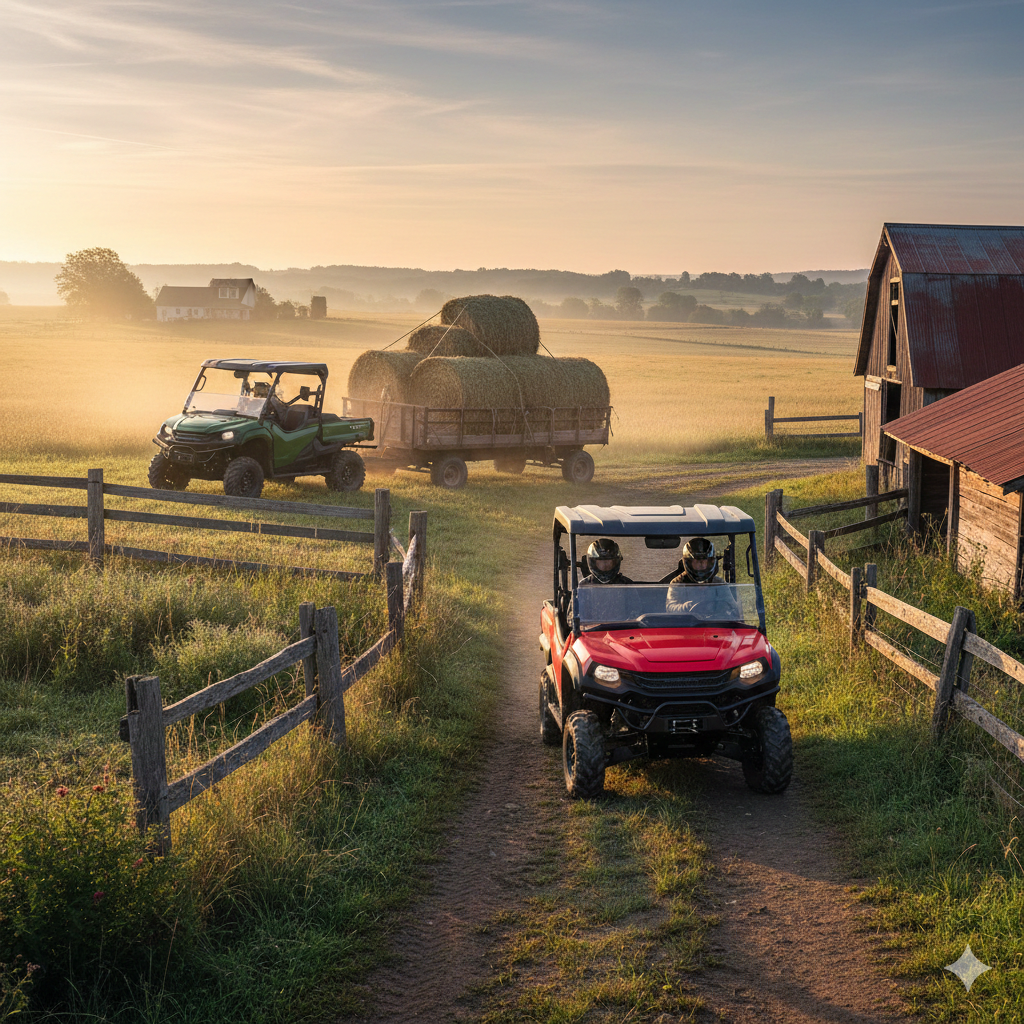
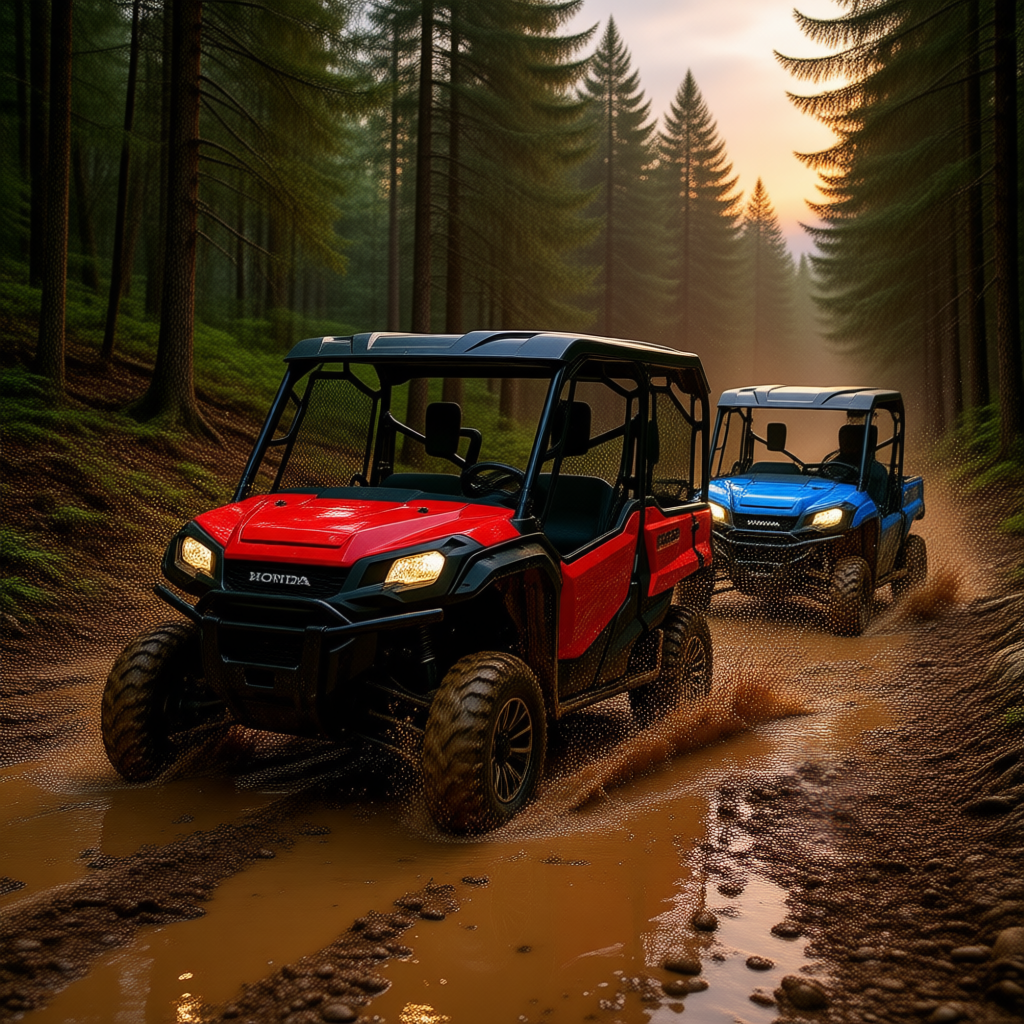
The Pioneer 700 and 520 working hard on the farm.
Engine Power and Performance: Comparing the Workhorses
When it comes to serious farm work, engine power and torque delivery matter immensely. Looking at the 520 & 700 side by side, the differences in their powerplants dictate how they perform under load. The Honda Pioneer 700 is powered by a robust 675cc liquid-cooled, four-stroke single-cylinder engine that delivers reliable, consistent power for hauling and towing. This engine is fuel-injected, which means it starts reliably in freezing cold weather and performs consistently across different altitudes and temperatures. Furthermore, the Pioneer 700’s engine is rubber-mounted to reduce cabin vibration, making long workdays significantly more comfortable for the operator.
The Honda Pioneer 520, on the other hand, features a more compact 518cc liquid-cooled engine that’s specifically optimized for low-RPM torque. This smaller engine is also fuel-injected and provides excellent pulling power for its size. For 2026, Honda refined the transmission gear ratios on the 520, resulting in a 23-percent increase in top speed while maintaining the torquey character that makes it perfect for farm work. The 520’s engine is lighter and more compact, which contributes to the machine’s overall agility, lower center of gravity, and superior maneuverability in tight spaces.
In terms of raw horsepower, the Pioneer 700 has a clear advantage. However, the Pioneer 520’s focus on low-end grunt makes it surprisingly capable for many daily farming tasks. The choice between these engines depends entirely on the types of work you’ll be doing. If you’re regularly hauling heavy loads of feed, towing large trailers, or pulling ground-engaging equipment, the 700’s extra power is absolutely vital. If you’re doing lighter work, checking fences, and prioritize nimble maneuverability over brute force, the 520’s compact engine is more than adequate.
Transmission Differences: Dual-Clutch vs. CVT
One of the most significant mechanical differences between these two models lies in how they put power to the ground. The Pioneer 700 utilizes Honda’s renowned 5-speed automatic Dual-Clutch Transmission (DCT). This system uses two clutches—one for odd gears and one for even gears—to deliver lightning-fast, seamless shifts without the need for a traditional clutch lever. It also features paddle shifters, allowing the operator to manually select gears when crawling over obstacles or engine-braking down steep hills with a heavy load.
The Pioneer 520, conversely, uses a Continuously Variable Transmission (CVT) with an automatic centrifugal clutch. While CVTs are often criticized in the off-road world for belt slippage under extreme loads, Honda has tuned the 520’s CVT specifically for utility work. It provides a smooth, stepless acceleration that is incredibly easy to modulate when driving through delicate crops or tight barn aisles. For the average farmer, both transmissions are highly reliable, but the DCT on the 700 offers a more direct, mechanical feel that heavy-towing enthusiasts appreciate.
Towing and Hauling Capacity: The Heavy-Lifting Difference
This is where the comparison really matters for serious agricultural work. The honda pioneer 700 towing capacity is a massive 1,500 pounds, which is 50 percent more than the Pioneer 520’s 1,000-pound towing limit. For farmers who regularly haul trailers filled with hay, feed, fertilizer, equipment, or livestock supplies, this extra capacity is a game-changer. The Pioneer 700 can handle larger utility trailers, heavy equipment trailers, and even small livestock trailers without straining the engine or overheating the transmission.
The cargo bed capacity tells a similar story. The Pioneer 700 offers a 1,000-pound bed capacity, allowing you to haul substantial loads of seed, tools, fencing materials, or harvest yields. The Pioneer 520’s bed capacity is 450 pounds, which is still respectable for lighter loads but limits what you can carry in a single trip. If you’re frequently moving heavy items like tractor batteries, fence posts, or bulk feed around your property, the Pioneer 700’s larger bed and superior towing capacity will drastically reduce the number of trips and save you valuable time.
That said, the Pioneer 520’s 1,000-pound towing capacity is still quite capable for many farming operations. If you’re working with smaller utility trailers, dragging harrows, or moving lighter loads, the 520 will handle the job without any issues. The key is honestly assessing your typical maximum workload and choosing a machine that isn’t constantly operating at its absolute limit.
Check out our off-road collection Amazon products
SHOP THE COLLECTION
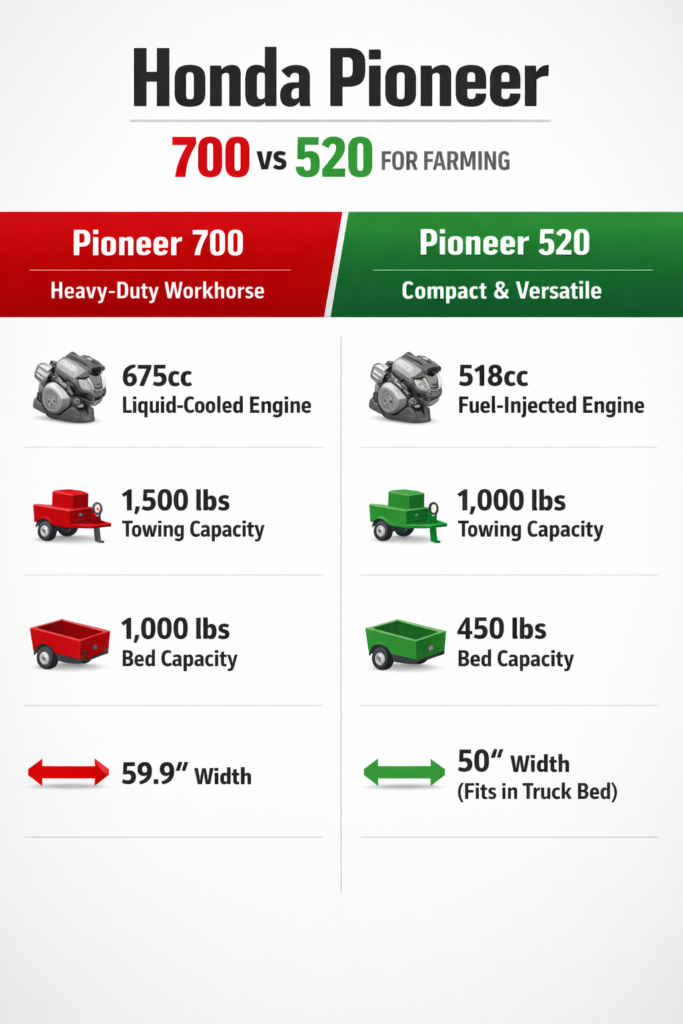
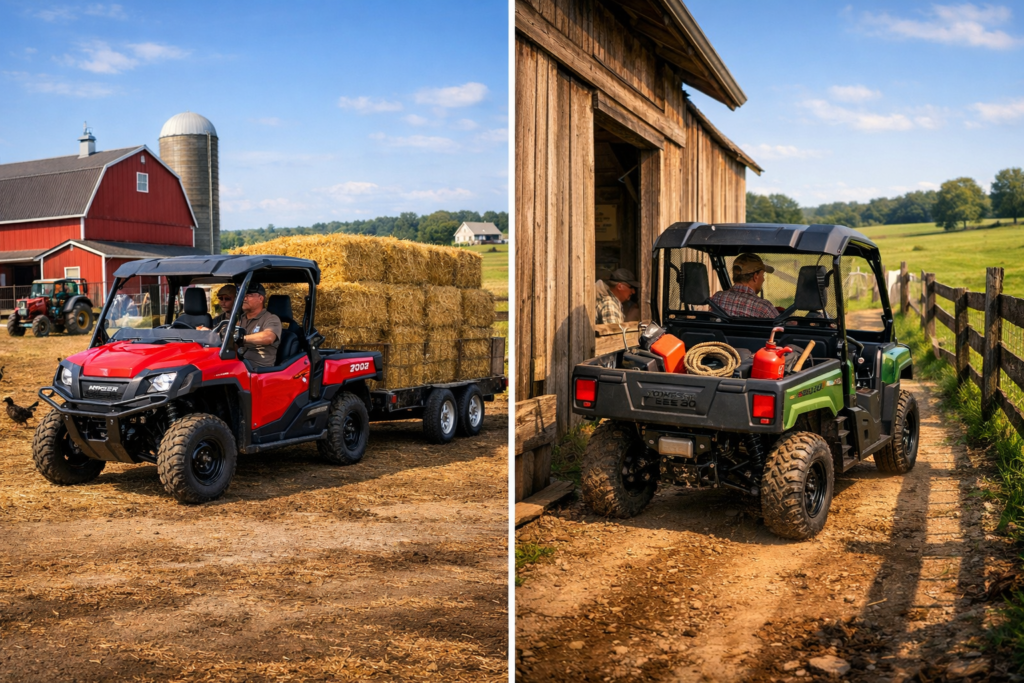
Key specifications and farming capabilities at a glance.
Size and Maneuverability: Navigating Your Property
One of the most important considerations for farm use is how easily your UTV can navigate tight spaces, old barns, and dense woods. The Pioneer 520 has a significant advantage here. With a width of just 50 inches, the Pioneer 520 is narrow enough to fit through most standard gates, between tightly spaced orchard rows, and even fits perfectly in the bed of a full-sized pickup truck. This makes it incredibly versatile for farmers who need to transport their UTV to different properties, leased hunting grounds, or remote pastures without needing a dedicated trailer.
The Pioneer 700, by contrast, is 59.9 inches wide. While this extra width provides a more spacious cabin, better shoulder room, and superior lateral stability when hauling heavy loads, it can be limiting if you have narrow passages, tight gates, or confined work areas. The Pioneer 700 won’t fit in most pickup truck beds, which means you’ll absolutely need a trailer and a capable tow vehicle if you want to transport it off your property.
For farmers with large, open properties where maneuverability isn’t a major concern, the Pioneer 700’s extra width is a non-issue and actually adds to the confident ride quality. However, if you’re working on a smaller property with tight spaces, dense timber, or if you need to transport your UTV frequently, the Pioneer 520’s compact footprint is a major advantage. Many farmers deeply appreciate the 520’s ability to squeeze through gates without opening them and navigate between buildings and parked equipment effortlessly.
Recommended Insights From Our Guide Library:
Suspension, Ground Clearance, and Ride Quality
Farm terrain is rarely smooth. You’ll be dealing with ruts, rocks, mud, and uneven fields. Both the 520 and 700 feature independent front and rear suspension, but their setups are tuned differently. The Pioneer 700 offers slightly more ground clearance (10.1 inches) compared to the 520 (9.1 inches). The 700 also features a longer wheelbase, which helps it bridge over deep ruts and large obstacles without bottoming out.
The Pioneer 520 has a shorter wheelbase, making it incredibly nimble, but it can feel a bit more “bouncy” when driving over washboards or large bumps without a load in the bed. However, when loaded with 400 pounds of feed, the 520’s suspension settles down and provides a very plush ride. If your farm features extremely rough, rocky terrain, the 700’s longer travel and heavier-duty shocks will provide a more controlled and comfortable experience.
Comfort and Control: Long Days in the Saddle
Farm work often means spending 8 to 12 hours a day in your UTV, so operator comfort is paramount. The Honda Pioneer 700 offers a more spacious cabin with a wider stance, which provides better stability when hauling heavy loads. The larger frame means significantly more legroom and shoulder room for the driver and passenger, making it more comfortable for extended work sessions, especially if you are carrying a farmhand or family member. The Pioneer 700 comes with a tilting steering wheel and available Electric Power Steering (EPS) on Deluxe and Forest models, which drastically reduces arm fatigue during long days of driving.
The Pioneer 520 is more compact, but Honda has designed it with surprising ergonomics in mind. The spacious bench-style seat with individual backrests and seatbelts provides good support for both driver and passenger. Because it lacks EPS (relying instead on a very well-balanced steering geometry), the steering is slightly heavier at low speeds, but the 520’s lighter weight and nimble handling characteristics make it feel highly responsive and engaging to drive, which some farmers actually prefer. The 520 also features a tilting steering wheel for easier entry and exit.
Both machines feature intuitive dash layouts, easy-to-reach controls, and Honda’s legendary build quality. For ultimate comfort, the choice depends on whether you prefer the spacious, car-like feel of the 700 or the tight, nimble handling of the 520.
Specifications Comparison Table
| Feature | Honda Pioneer 700 | Honda Pioneer 520 |
|---|---|---|
| Engine | 675cc Liquid-Cooled Single | 518cc Liquid-Cooled Single |
| Towing Capacity | 1,500 lbs | 1,000 lbs |
| Bed Capacity | 1,000 lbs | 450 lbs |
| Width | 59.9 inches | 50 inches |
| Transmission | 5-Speed Automatic DCT | Automatic CVT |
| Ground Clearance | 10.1 inches | 9.1 inches |
| Starting Price | $12,899 | $10,999 |
Honda Pioneer 500 vs 700: A Quick Look at the Legacy
If you are shopping the used market, you might find yourself looking at an older honda pioneer 500 vs 700 comparison. The Pioneer 500 was the predecessor to the 520 and served as Honda’s entry-level compact utility vehicle for many years. While the 500 was a fantastic, reliable machine, it lacked the top-end speed and refined CVT tuning found in the newer 520.
When comparing a used Pioneer 500 to a new or used Pioneer 700, the same core principles apply: the 700 offers vastly superior towing (1,500 lbs vs 1,000 lbs), a larger bed, and a wider stance. However, the Pioneer 500 remains a highly sought-after machine for farmers who need a narrow, lightweight UTV that can easily be loaded into a pickup truck. If you find a well-maintained Pioneer 500, it can still be a phenomenal farm hand, though you will sacrifice the modern updates, increased top speed, and warranty coverage of a newer 520 or 700.
Reliability and Durability: Built to Last
Both the Honda Pioneer 700 and 520 are built on Honda’s proven, over-engineered platform, which means you’re getting legendary reliability in either case. Honda’s reputation for durability is well-earned, and both of these machines are designed to withstand years of hard, abusive farm work with only basic maintenance. The liquid-cooled engines in both models are proven performers, and the fuel injection systems ensure reliable starts in cold weather and consistent performance in any condition, whether you are at sea level or high in the mountains.
The Pioneer 700’s larger engine and heavier-duty drivetrain components make it particularly well-suited for sustained heavy work. If you’re regularly pushing the machine to its limits with maximum loads, the 700’s more robust design will likely have a longer service life without requiring major overhauls. However, the Pioneer 520 is also built to last, and many farmers have successfully used them for thousands of hours of consistent farm work without major issues.
Honda’s dealer network is extensive, and parts are readily available for both models. This is crucial for farm equipment, as downtime during planting or harvest season can be incredibly costly. Whether you choose the 700 or 520, you’ll have access to genuine Honda parts, detailed service manuals, and qualified service technicians wherever you are.
“The choice between these two machines comes down to your specific farming needs. The 700 is the right choice if you regularly haul heavy loads, while the 520 is perfect for farmers who value maneuverability and don’t need maximum towing capacity.” – My perspective as a farm equipment enthusiast.
Price and Value: Getting the Most for Your Money
The Honda Pioneer 520 starts at $10,999, while the Pioneer 700 starts at $12,899. That’s a difference of nearly $2,000, which is significant for many farm operations operating on a strict budget. The Pioneer 520 offers exceptional value for farmers who don’t need the extra towing and bed capacity. You’re getting a reliable, durable Honda machine at a much more accessible price point, leaving you extra cash to invest in a winch, a snowplow, or a set of heavy-duty tires.
The Pioneer 700’s higher price directly reflects its increased capabilities and larger physical footprint. If you regularly need to tow 1,500 pounds or haul 1,000-pound loads, the extra investment in the 700 will pay for itself through increased efficiency, fewer trips across the field, and reduced operator fatigue. However, if you’re doing lighter work, the 520’s lower initial price and slightly better fuel consumption make it the more economical choice over a 10-year ownership period.
Consider your long-term farming plans when making this decision. If you think you’ll be expanding your herd, buying more property, or taking on heavier chores in the future, investing in the 700 now might be the smarter choice to avoid having to upgrade again in a few years. If you’re confident that the 520’s capabilities will perfectly match your needs for years to come, the savings are substantial.
Final Verdict: Making Your Decision
The honda pioneer 520 vs 700 decision ultimately depends on the unique layout and demands of your specific farming operation. Choose the Honda Pioneer 700 if you regularly haul heavy loads, tow large trailers, carry multiple workers, or operate on a large property where you need maximum hauling capacity and ground clearance. The 700’s extra power, Dual-Clutch Transmission, and larger bed capacity will reduce the number of trips and increase your daily efficiency, making it the undisputed right choice for demanding, heavy farm work.
Check out our off-road collection Amazon products
SHOP THE COLLECTIONChoose the Honda Pioneer 520 if you’re working on a smaller property, have tight spaces and narrow gates to navigate, need to transport your UTV in a pickup truck frequently, or simply don’t require maximum towing capacity. The 520’s compact 50-inch size, lower price point, and excellent fuel efficiency make it an outstanding value for farmers, orchard managers, and homesteaders who prioritize agility over brute strength.
Both machines are built on Honda’s proven platform and will serve you reliably for decades if properly maintained. The key is honestly evaluating your specific needs, property terrain, and budget, and choosing the machine that matches your operation. Either way, you’re investing in a legendary workhorse that will earn its keep on your farm.
What’s your farming operation like? Are you leaning toward the 700 or the 520? Share your thoughts and experiences in the comments below!
Best regards,
Recommended Resources
- Video: Honda Pioneer 700 & Foreman 520 Compared: ATV vs Side-by-Side (18:30) – A detailed comparison of these two Honda workhorses.
- Video: We Ordered a Honda Pioneer 520 but Purchased a 700 (24:15) – Real owner experience and comparison after using both machines.
- Outbound Link: Official Honda Pioneer 700 Features Page – Complete specifications and features from Honda.
- Outbound Link: Official Honda Pioneer 520 Features Page – Detailed specs and capabilities for the 520.
- Outbound Link: Honda SxS Forum: Pioneer 700 vs 520 Discussion – Real owner experiences and insights from the community.
References
- Honda Powersports: Pioneer 700 Features and Specifications
- Honda Powersports: Pioneer 520 Features and Specifications
- YouTube: Honda Pioneer 700 & Foreman 520 Compared
- YouTube: We Ordered a Honda Pioneer 520 but Purchased a 700
- Honda SxS Forum: Pioneer 700 vs 520 Size Difference Discussion



Community Reference & Authority Resources:
🔍 Explore More: See all guides for Honda Pioneer.