

When it comes to thermo tec heat barrier honda pioneer, getting the right details matters.
If you operate a utility vehicle in demanding terrain, you recognize that cabin heat accumulation is more than an inconvenience—it is a structural threat. This guide delivers the exact installation parameters required to mount a thermo tec heat barrier honda pioneer owners rely on for long-term durability. We bypass generic foil solutions that degrade rapidly, focusing instead on engineered thermal management aligned with modern chassis architecture. You will learn how to identify radiant transfer vectors, calculate exact frame gap dimensions, and apply manufacturer-specified torque values. The result is a permanent reduction in under-seat ambient temperatures.
Diagnosing the Pioneer Cab Overheat: Radiant Transfer, Steam Convection, and Frame Gaps
Understanding thermal ingress requires analyzing the physical forces attacking the chassis. Heat does not simply circulate; it exploits specific material weaknesses and unsealed apertures.
Direct Radiant Heat Transfer from Mid-Mounted Engine Blocks
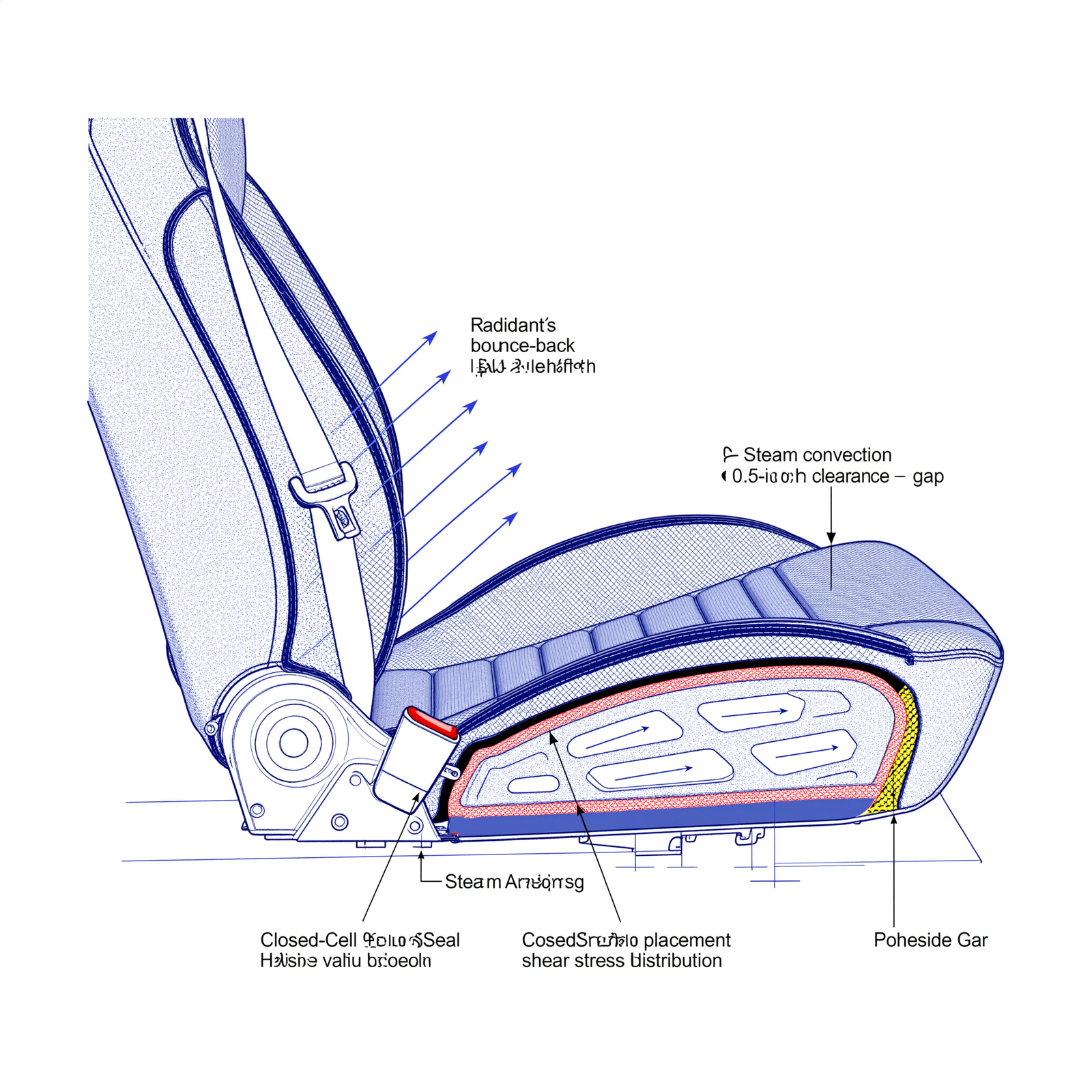
The powertrain sits directly beneath the seating area. During low-speed technical crawling, crankcase surface temperatures routinely exceed 450°F. This thermal energy radiates upward through the 3mm-thick polypropylene seat pans.
Driver exposure manifests as intense localized burning on the thighs after extended operation. The factory plastic acts as a thermal conductor rather than a protective insulator.
Mud-Induced Steam Convection Forcing Heat Through Seatbelt Slots
Trail mud contacting hot engine components vaporizes instantly upon impact. The resulting steam follows the path of least resistance, forcing its way through the 0.75″ x 1.5″ seatbelt mounting apertures.
Operators experience sudden bursts of humid heat near the legs during light throttle application. This phenomenon indicates steam bypassing existing insulation through unsealed chassis holes.
Model-Specific Seat Frame Latch Failure and Rear Gaps
Recent chassis revisions widened the seat frame latch design, creating a consistent 0.3″ aperture at the rear mounting points. Older shielding geometries cannot bridge this modern architectural variance.
Unfiltered radiation penetrates directly into the cabin through this newly exposed channel. Using legacy cutting templates guarantees incomplete coverage and persistent hot spots.
OEM Polypropylene Seat Pan Warping at Sustained Temperatures
Continuous exposure to under-seat environments above 300°F induces progressive polymer deformation. Within six months of operation, critical insulation clearance drops below 0.25″.
The seat bottom begins to sag or warp under rider weight. Proximity to the exhaust system accelerates material degradation and compromises long-term structural integrity.
The Hardware Solution: Thermo-Tec Super 150 Mil Specifications
Thermal mitigation demands hardware rated for extreme operating conditions. The selected barrier represents the current industry benchmark for this specific application.
Check out our off-road collection Amazon products
Thermal Resistance Ratings: Radiant vs. Direct Contact
The 150 mil (3.8mm) composite core withstands 1000°F radiant exposure and 400°F direct contact without delamination. Standard 50 mil alternatives fail immediately under equivalent load. Independent ASTM E408-17 validation confirms 95% radiant deflection efficiency.
Reflected thermal energy returns toward the source instead of transferring into the cabin. Operator comfort remains stable even during sustained high-RPM climbs.
Platform Fitment Dimensions and Cutting Tolerances
| Platform Generation | Primary Cut Dimensions | Trim Requirement | Aperture Coverage | Pioneer 1000-5/1000-6 (Current Gen) | 24.5″ x 18.75″ | None | Full rear latch coverage | Pioneer 1000 Series (Legacy Gen) | 23.0″ x 17.0″ | 0.5″ rear trim | Standard latch alignment | Pioneer 700 Series (Recent) | 22.25″ x 17.5″ | Contoured edge | Optimized slot clearance |
|---|
Undersized installations allow thermal bypass along the perimeter edges. Oversized cuts interfere with mechanical latching mechanisms and compromise safety retention.
Butyl Adhesive Shear Strength and Surface Prep Requirements
The proprietary butyl compound maintains 20 psi shear strength across a -40°F to 350°F operational range. Successful adhesion mandates 90% isopropyl alcohol degreasing prior to application. Skipping this step guarantees premature detachment within three weeks.
Chassis vibration will shake loose panels if the substrate remains contaminated. Proper surface preparation ensures permanent bonding through years of aggressive off-road cycling.
Ceramic Coating Upgrade vs. Aluminum Foil Layer
Current manufacturing iterations integrate a specialized ceramic topcoat, replacing older aluminum foil laminates. This modification delivers a 15% increase in ultraviolet stability and scratch resistance.
Extended sun exposure during routine maintenance will not cause flaking or oxidation. The shield retains its reflective properties and structural cohesion in harsh outdoor environments.
Recommended Insights From Our Guide Library:
- Beat the Heat: How to Reduce Heat in Your UTV Cab – Pioneer Honda Lovers
- under-seat heat shield Archives – Pioneer Honda Lovers
- Beat the Burn: The Ultimate Guide to Under-Seat Heat Mitigation for Off-Roaders – Pioneer Honda Lovers
- Is Your Honda Pioneer a Sauna? The Ultimate Guide to Cool Cab Upgrades
- heat shielding Archives – Pioneer Honda Lovers
Technical Setup Blueprint: Installation Torque, Tooling, and Steam Sealing Protocols
Execution precision dictates long-term performance. Strict adherence to these mechanical protocols guarantees optimal thermal management and chassis preservation.
Seat Removal Protocols: Torx Drivers and Latch Clip Release
| Component Type | Fastener Specification | Torque Value | Release Method | Legacy Models | 4x T25 Torx | 15 ft-lbs | 2x 7mm push pins | Current Models | 2x T30 Torx | 18 ft-lbs | 4x flathead latch clips | Plastic Retainers | N/A | Hand-tight only | Flathead screwdriver |
|---|
Incorrect bit selection strips fastener heads and damages surrounding sheet metal. Utilizing the specified driver set prevents costly frame repairs and accelerates disassembly.
Critical Steam Seal: Closed-Cell Foam for Seatbelt Slots
Applying 1.0″ x 2.0″ closed-cell foam over the seatbelt apertures is mandatory before barrier placement. Cutting through these channels without sealing creates immediate convection leaks.
This step eliminates 0.75″ shrinkage vulnerabilities and stops superheated moisture from reaching the operator. The foam completely blocks the convective pathway identified during initial diagnostics.
Barrier Clearance Rules: Gap from Crankcase Midpoint
Maintain a strict minimum 0.5″ separation between the shield surface and the engine block midpoint. Edge contouring must match the seat pan geometry within a 1/16″ tolerance using precision shears.
Insufficient clearance causes rapid thermal breakdown and potential ignition. Excessive distance allows unshielded radiation to bypass the reflective surface entirely.
Active Evacuation Integration: Bilge Fan, Ducting, and Fuse Tap
Check out our off-road collection Amazon products
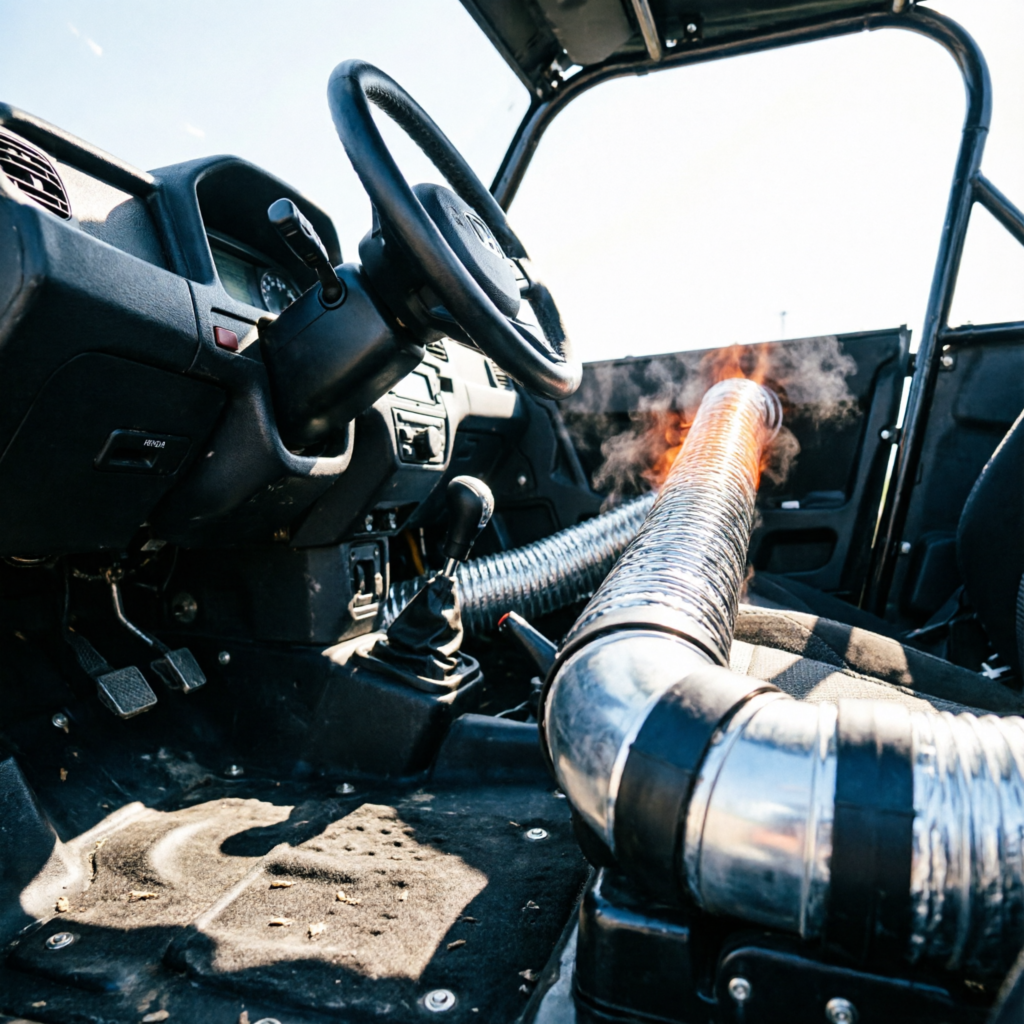
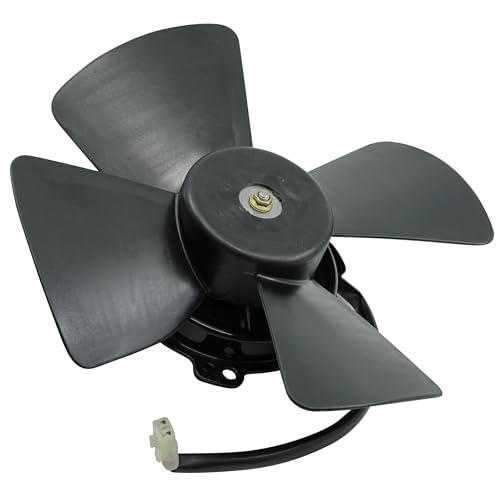
Static shielding cannot resolve trapped heat pockets alone. Routing 3″ flexible ducting with a minimum 150 CFM extraction rate actively purges the under-seat cavity. Power delivery requires a 15A fuse tap on a key-on circuit using 14-gauge stranded wire.
Forced air circulation works synergistically with the thermal barrier to maintain cabin viability. Ambient temperatures remain controlled during prolonged technical navigation.
Field Verdict & Operational ROI: Preventing Deformation and Adhesive Failure
Real-world deployment data validates the necessity of specification-matched components. Substandard alternatives consistently collapse under actual trail conditions.
Forum Consensus: Generic Barrier Melting Thresholds
Cross-referenced operator reports indicate budget-friendly Amazon listings adhere to seat surfaces after melting at 300°F. The premium 150 mil variant maintained structural integrity, though improper slot cutting caused minor dimensional shrinkage.
Low-cost shields create hazardous residue and demand complete reinstallation. Investing in correct thickness specifications eliminates repeat labor and material waste.
Long-Term Durability: Shrinkage Prevention and Peel-Off
Manufacturer warranty claims frequently cite adhesive breakdown due to inadequate substrate cleaning. Current generation front hinge architectures require exact 24.5″ x 18.75″ profiling to eliminate peripheral leaks.
Methodical execution quantifies the lifespan differential between budget and premium materials. Operators avoid recurring heat leaks and peeling edges that return after seasonal use.
Final Torque Specs: Seat Mounting Bolt Compliance
Reassembly must strictly follow OEM specification 07WAF-S3A0000. Apply 15-18 ft-lbs to all primary seat mounting bolts. Exercise extreme caution with plastic retention clips, tightening only until snug to prevent fracture.
Correct fastening pressure guarantees occupant safety and chassis rigidity. Over-torquing synthetic retainers cracks the frame housing, triggering persistent rattles and unsafe seat displacement.
Community Reference & Authority Resources:
Conclusion
Success becomes undeniable the first time you navigate a technical rock garden without instinctively shifting your weight to escape concentrated heat.
You have successfully sealed the rear chassis aperture, blocked steam convection pathways, and redirected extreme radiant energy away from the cabin. This procedure transcends simple adhesive application; it represents precise mechanical engineering applied to comfort and longevity.
By deploying the correctly specified thermal shield, adhering to modern dimensional tolerances, and sealing all convective channels, you transform the interior environment.
Cabin temperatures stabilize. Structural components remain secure. The trail ahead remains completely open.
🔍 Explore More: See all Wild Testing guides for thermo tec heat barrier honda pioneer.
Check out our off-road collection Amazon products