
Hey there, fellow off-road enthusiasts! If you’re currently torn between the kawasaki mule pro fxt vs honda pioneer 1000-5, you’ve come to the right place. I’ve spent countless hours on the trails and in the fields, and I know exactly how tough this decision can be. Both of these machines are absolute legends in the UTV world, but they cater to slightly different needs. One is the undisputed king of the ranch, while the other is a high-tech trail blazer that refuses to compromise on performance.
In this comprehensive guide, I’m going to break down everything you need to know about these two beasts. We’ll look at their unique seating configurations, their engine characteristics, and how they handle everything from hauling lumber to climbing rocky ridges. I’ll share my personal insights and the technical specs that actually matter when you’re out in the middle of nowhere. By the time we’re done, you’ll have a clear winner for your specific lifestyle. Let’s dive in!
Seating Versatility: Trans Cab vs. QuickFlip
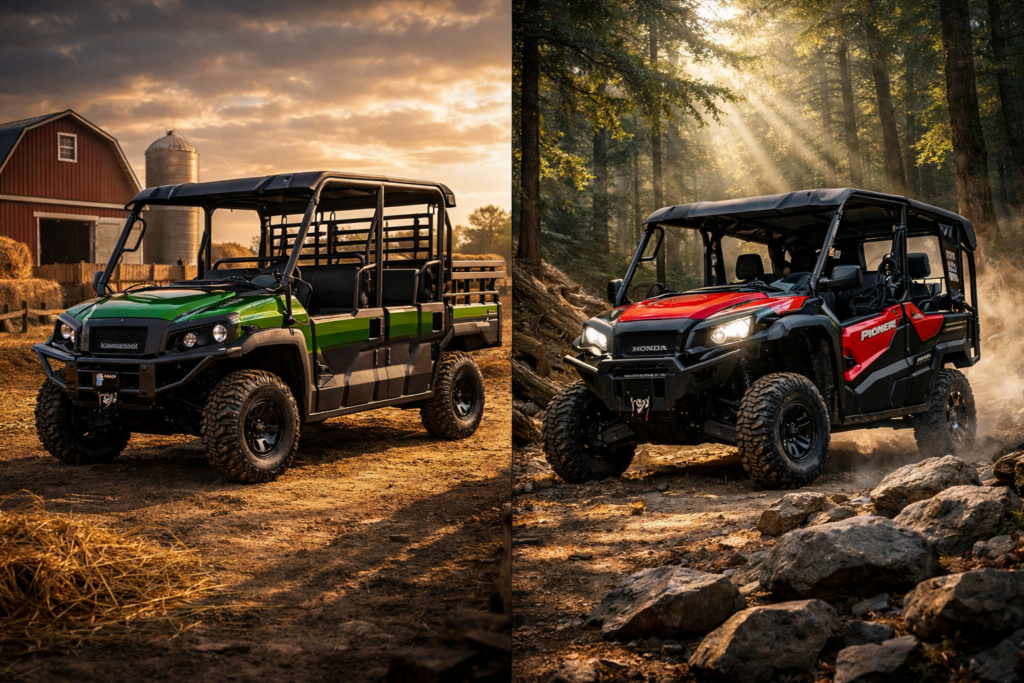
One of the biggest selling points for both the kawasaki mule pro fxt vs honda pioneer 1000-5 is their ability to carry more than just a driver and a passenger. However, they achieve this in very different ways. The Kawasaki Mule Pro FXT features the legendary “Trans Cab” system. This allows you to easily convert the machine from a 3-person configuration with a massive cargo bed to a 6-person crew cab in about a minute. It’s a brilliant design that makes the Mule incredibly versatile for large families or work crews.
The Honda Pioneer 1000-5 uses what they call “QuickFlip” seating. Instead of moving the entire cab wall, the Pioneer has two extra seats tucked away in the bed. You can flip them up individually, allowing for 3, 4, or 5-person seating. The beauty of the Honda system is that it maintains a shorter wheelbase, which is a massive advantage on tight trails. However, when the seats are up, you lose almost all of your bed space. In the kawasaki mule pro fxt vs honda pioneer 1000-5 seating battle, the Mule wins on capacity, but the Honda wins on agility.
| Feature | Kawasaki Mule Pro FXT | Honda Pioneer 1000-5 |
|---|---|---|
| Max Seating | 6 Persons | 5 Persons |
| Seating System | Trans Cab (Sliding Wall) | QuickFlip (In-Bed Seats) |
| Wheelbase | 92.3 inches | 80.2 inches |
I’ve found that if you’re primarily using your UTV for work on a farm, the Mule’s ability to carry six people and still have a decent bed is a game-changer. But if you’re a trail rider who occasionally brings the kids along, the Honda’s compact size makes it much easier to navigate through the woods. It’s all about how you plan to spend your time behind the wheel.
Engine and Transmission: Smooth CVT vs. High-Tech DCT
When we talk about the kawasaki mule pro fxt vs honda pioneer 1000-5 performance, we’re looking at two very different philosophies. The Kawasaki is powered by an 812cc three-cylinder engine. It’s not the fastest machine on the block, with a top speed limited to around 45 mph, but it is incredibly smooth and quiet. It uses a traditional CVT (Continuously Variable Transmission) that is tuned for low-end torque and reliability. It’s a “set it and forget it” kind of power that just works.
The Honda Pioneer 1000-5 is a different animal entirely. It boasts a 999cc twin-cylinder engine that is much more aggressive. But the real star of the show is the 6-speed Dual-Clutch Transmission (DCT). There are no belts to worry about here. It shifts like a modern car, and you can even use paddle shifters to take manual control. The Honda is significantly faster, reaching speeds of over 60 mph. In the kawasaki mule pro fxt vs honda pioneer 1000-5 power struggle, the Honda is the clear winner for performance enthusiasts.
“The Kawasaki Mule is the quietest, smoothest workhorse I’ve ever driven. It’s not a racer, but it will outlast almost anything on the farm. The Honda, however, is a blast on the trails with that DCT.” — A common sentiment among UTV owners.
One thing to consider is maintenance. CVT belts eventually need replacing, especially if you’re doing a lot of heavy towing. The Honda’s DCT is a gear-on-gear system that is theoretically more durable, but it’s also more complex. Honda’s reputation for reliability is legendary, but Kawasaki offers a class-leading 3-year warranty on the Mule, which gives a lot of peace of mind. In the kawasaki mule pro fxt vs honda pioneer 1000-5 reliability debate, it’s a tough call.
Ride Quality and Handling
The kawasaki mule pro fxt vs honda pioneer 1000-5 handling characteristics are defined by their wheelbases. The Mule is long and stable. It has a very plush ride that soaks up bumps like a luxury SUV. It’s incredibly comfortable for long days of work. However, that long wheelbase means it has a larger turning radius, which can be a bit of a pain in tight spots. It’s a machine that prefers open spaces and wide trails.
The Honda Pioneer 1000-5 feels much more like a sport-utility hybrid. It’s agile, responsive, and loves to be pushed. The shorter wheelbase makes it a dream on technical trails where you’re constantly weaving between trees. The suspension is a bit firmer than the Mule’s, but it offers better bottoming resistance for aggressive riding. In the kawasaki mule pro fxt vs honda pioneer 1000-5 trail test, the Honda is the more exciting ride, while the Mule is the more relaxing one.
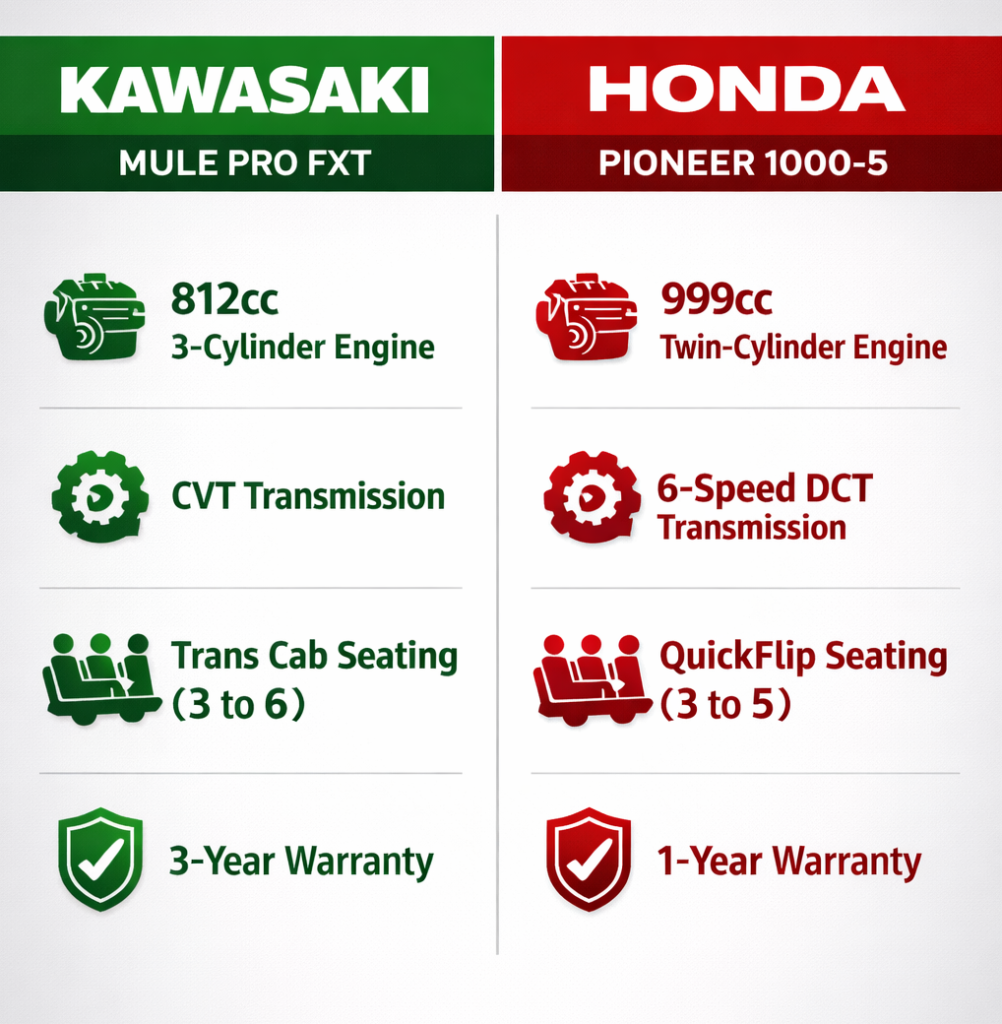
A quick comparison of the key technical differences between the Mule and the Pioneer.
Ground clearance is another factor. The Honda typically sits a bit higher, which is great for clearing rocks and logs. The Mule is a bit lower to the ground, which makes it easier to get in and out of—a big plus if you’re doing chores all day. Both machines feature excellent 4WD systems with locking differentials, so you won’t be getting stuck easily in either one. In the kawasaki mule pro fxt vs honda pioneer 1000-5 off-road capability check, both are top-tier.
Work Capabilities: Hauling and Towing
If you’re buying a UTV for work, the kawasaki mule pro fxt vs honda pioneer 1000-5 comparison gets very interesting. The Mule is built for the ranch. Its bed is huge in the 3-person mode, and it can haul up to 1,000 lbs (depending on the model and seating config). It’s also rated to tow 2,000 lbs. The bed is made of steel, which is incredibly durable for hauling rocks, firewood, or heavy tools. It’s a machine that isn’t afraid to get dirty.
The Honda Pioneer 1000-5 is also a capable worker, with a 1,000 lb bed capacity and a superior 2,500 lb towing capacity. However, the bed is smaller than the Mule’s, especially when you have those extra seats flipped up. The Honda’s DCT is excellent for towing because it doesn’t have a belt that can slip under load. In the kawasaki mule pro fxt vs honda pioneer 1000-5 work-off, the Mule is better for hauling bulky items, while the Honda is better for heavy towing.
Expert Resources and Reviews
To help you make the most informed decision, I’ve gathered some of the best resources from around the web. These experts go even deeper into the nitty-gritty details of the kawasaki mule pro fxt vs honda pioneer 1000-5:
- StarknightMT’s Detailed Comparison – A great breakdown of comfort and handling.
- ATV.com Comparison Video – See these machines in action side-by-side.
- 2025 Model Comparison – A look at the latest features for the newest models.
- Wood Powersports Blog – Expert advice on choosing between the two for farm use.
- Rokslide Forum Discussion – Real-world feedback from hunters and outdoorsmen.
And if you’re a visual learner, these YouTube videos are a must-watch. They provide a great sense of the scale and performance of the kawasaki mule pro fxt vs honda pioneer 1000-5:
A classic comparison showing the strengths of both the Pioneer and the Mule.
Which one is the ultimate winner? This video breaks down the final verdict.
Conclusion: Which UTV Wins?
So, after looking at the kawasaki mule pro fxt vs honda pioneer 1000-5 from every angle, which one should you buy? The answer depends entirely on your priorities. If you need a machine that can carry six people, has a massive cargo bed, and offers a buttery-smooth ride for all-day work, the Kawasaki Mule Pro FXT is the undisputed champion. It’s the ultimate utility vehicle for the ranch or the farm, backed by an incredible 3-year warranty.
However, if you want a machine that is a blast to drive, features cutting-edge transmission technology, and can handle tight trails with ease, the Honda Pioneer 1000-5 is the way to go. It’s the perfect choice for the enthusiast who wants a vehicle that can work hard during the week and play even harder on the weekends. You really can’t go wrong with either one—it’s just a matter of which flavor of off-roading you prefer.
What’s your take? Are you leaning towards the reliability of the Mule or the performance of the Pioneer? Have you had any experiences with either of these machines? I’d love to hear your thoughts in the comments below. Let’s keep the conversation going!
See you out there,
References
- Kawasaki Mule vs Honda Pioneer, which is better? – StarknightMT
- 2017 Honda Pioneer 1000 EPS vs. Kawasaki Mule Pro-FX LE – ATV.com
- 2025 Honda Pioneer 1000 Deluxe vs 2025 Kawasaki Mule PRO-FXT 1000 LE Ranch Edition – Jay Hatfield Honda
- The Kawasaki Mule PRO or the Honda Pioneer 1000? – Wood Powersports
- Side by Sides (Pioneer vs Mule) – Rokslide Forum