



Polaris General vs Honda Pioneer 1000 Comfort: The Ultimate Ride Quality Showdown (2026 Update)
When you’re out on the trail for eight hours straight, “comfort” isn’t just a luxury—it’s a necessity. As a fellow off-road enthusiast who has spent countless weekends navigating everything from tight wooded trails to wide-open desert washes, I know that the difference between a great ride and a back-breaking one often comes down to the machine you’re sitting in. Today, we’re putting two titans of the crossover UTV world head-to-head in a battle of the seats: the Polaris General vs Honda Pioneer 1000 comfort showdown.
The Polaris General has long been hailed as the “king of crossover,” blending sport performance with utility capability. On the other side, the Honda Pioneer 1000 is the rugged, reliable workhorse that many claim offers a more refined, automotive-like experience. Interestingly, some buyers even mistakenly search for a honda general 1000 when trying to compare these two iconic brands—a testament to how closely matched they are in the public consciousness. But which one actually treats your body better when the terrain gets tough?
In this deep dive updated for 2026, we’ll explore everything from suspension geometry and cab ergonomics to noise levels, heat management, and long-day seating endurance. Whether you’re a weekend warrior, a rancher, or a dedicated trail explorer, this comprehensive comparison will help you decide which rig deserves a spot in your garage for those long-haul adventures. For more on the Honda Pioneer 1000 lineup, check out our detailed buyer’s guide.
Suspension Science: Fox Shocks vs. Self-Leveling Tech
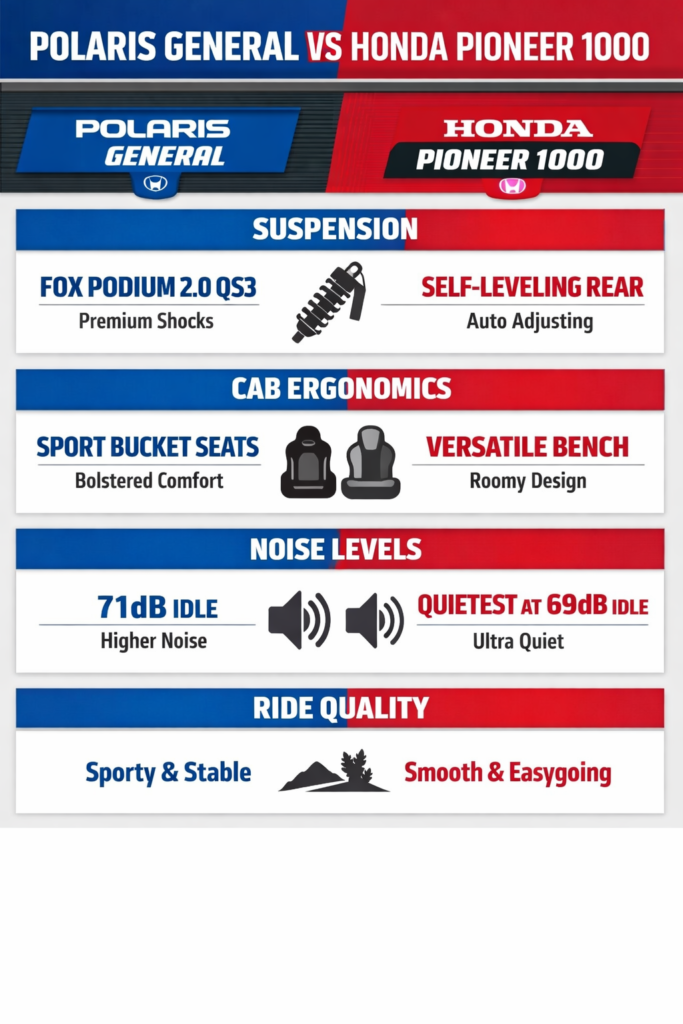
The foundation of any comfortable ride is the suspension system. It’s the first line of defense against trail chatter, whoops, and unexpected obstacles. The Polaris General, particularly in its XP trims, comes standard with premium Fox Podium 2.0 QS3 shocks. These are not just high-performance dampers; they are designed with user-friendly adjustability in mind. With a simple three-position switch, you can toggle between Soft, Medium, and Firm settings. This allows you to tailor the ride quality to the specific terrain you’re tackling, whether it’s slow-speed rock crawling or high-speed trail blasting.
The Honda Pioneer 1000 takes a different, more “set it and forget it” approach. While higher trims also feature Fox shocks, the standout feature on the Pioneer 1000-5 is its self-leveling rear suspension. This system uses a series of hydraulic chambers to automatically adjust the ride height based on the load in the bed or the number of passengers. This ensures that the suspension geometry remains optimal, preventing the “saggy rear” that often leads to a harsh, bottomed-out ride when fully loaded. For a deeper look at how the Pioneer handles heavy loads, read our Pioneer 1000-5 towing and payload guide.
In terms of pure plushness at low speeds, many riders find the Honda Pioneer to have a slight edge. Its suspension is tuned to soak up small trail chop and vibrations with remarkable efficiency. However, as the pace increases and the bumps get bigger, the Polaris General’s additional inches of travel and superior damping control start to shine. The General is built to handle the “whoops” and larger obstacles with a level of composure that the Pioneer can’t quite match. According to Polaris’ official specs, the General XP delivers class-leading wheel travel that directly translates to smoother high-speed impacts.
| Feature | Polaris General XP 1000 | Honda Pioneer 1000-5 |
|---|---|---|
| Front Travel | 14.0 inches | 10.6 inches |
| Rear Travel | 14.0 inches | 10.0 inches |
| Shock Type | Fox Podium 2.0 QS3 | Fox Podium 2.0 (on Deluxe/LE) |
| Special Tech | 3-Position Compression Adj. | Self-Leveling Rear Shocks |
| Ground Clearance | 13.5 inches | 12.4 inches |
Cab Ergonomics: Sport Buckets vs. Versatile Bench
When we talk about Polaris General vs Honda Pioneer 1000 comfort, we have to talk about where you actually sit. The Polaris General features true sport-style bucket seats with significant bolstering. These seats are designed to hold you firmly in place during aggressive cornering or off-camber sections. The ergonomics are very “cockpit-like,” with everything from the shifter to the switches falling intuitively to hand. The steering wheel is adjustable, and the overall feel is one of being “in” the machine rather than “on” it. For riders who prioritize lateral support and a performance-oriented driving position, the General’s cockpit is hard to beat.
The Honda Pioneer 1000 utilizes a modified bench-style seat in the front. While it lacks the deep bolstering of the General’s buckets, it offers a different kind of comfort: roominess. The bench is nicely padded and allows for easier entry and exit, which is a huge plus if you’re frequently hopping in and out for work or hunting. The center section is slightly raised to give a hint of a bucket feel for the driver and passenger, but it’s definitely a more “utility-first” design. One minor gripe often mentioned by taller riders is that the Pioneer’s steering wheel feels a bit large and could benefit from a wider range of tilt adjustment.
For 2026, both manufacturers have made subtle improvements to seat foam density and cover materials. The Polaris now uses a more breathable mesh insert on higher trims, reducing sweat buildup during summer rides. Honda has countered with thicker padding and improved lumbar contouring on the Pioneer 1000-5 LE. If you’re considering aftermarket upgrades, our UTV seat upgrade guide covers the best options for both platforms.
“The seating in the Polaris General is probably going to be more comfortable for pure trail riding, but I really have no complaints with the comfort of my Pioneer for all-day utility and exploration.” — Community Feedback from Off-Road Enthusiasts.
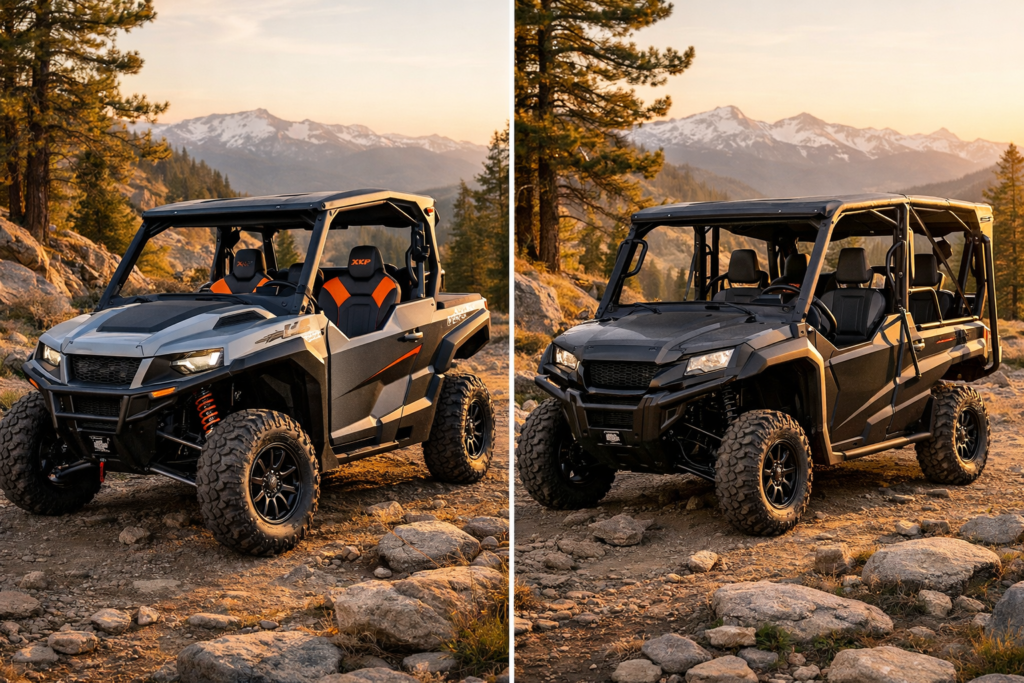
A quick look at the key comfort differences between these two crossover giants.
The Silent Treatment: Noise and Vibration Levels
Check out our off-road collection Amazon products
SHOP THE COLLECTIONOne of the most overlooked aspects of UTV comfort is cabin noise. High decibel levels can lead to rider fatigue and make communication with passengers nearly impossible without headsets. In this category, the Honda Pioneer 1000 is a standout performer. Thanks to its sophisticated Dual-Clutch Transmission (DCT) and well-insulated engine compartment, it is remarkably quiet. At idle, the Pioneer registers around 69 decibels, making it one of the quietest machines in its class. Even at a 30 mph cruise, it remains significantly quieter than the competition, allowing for easy conversation. Visit Honda Powersports for more technical details on their DCT engineering.
The Polaris General, while not “loud” by traditional sport UTV standards, definitely has more of a mechanical presence. Its CVT system and high-output ProStar engine produce a more traditional “drone” that increases with speed. At idle, it sits around 71 decibels, and at full throttle, it matches the Pioneer at roughly 98 decibels. However, the quality of the sound is different; the Honda feels more refined and automotive, while the Polaris feels more like a high-performance power tool. If a quiet cabin is your top priority for long-distance touring, the Honda is the clear winner here.
Vibration is another critical factor in long-day comfort. The Honda’s inline twin-cylinder engine with its counterbalancers produces noticeably less vibration through the steering wheel and seat compared to the Polaris parallel twin. Over a full day of riding, this reduction in high-frequency vibration can mean the difference between arriving back at the trailhead feeling refreshed versus feeling numb in your hands and feet.
Heat Management: Staying Cool in the Cockpit
If you’ve ever ridden in the Southern summer heat, you know that engine heat radiating into the cab can turn a fun ride into a sauna. Both Polaris and Honda have made strides in heat management over the years, and the 2026 models represent the best iterations yet. The Honda Pioneer 1000, with its engine located directly under the seat, has historically faced challenges with seat heat. However, newer models have significantly improved insulation and airflow to mitigate this. Honda engineers have added additional thermal barriers and redesigned the exhaust routing to keep heat away from the occupants.
The Polaris General, with its engine located further back in the chassis, generally does a better job of keeping the cockpit cool, though some heat can still creep in through the center console area. The General’s more open cab design also allows for better natural airflow, which helps during slow-speed technical sections where engine temperatures tend to spike. Both machines benefit greatly from aftermarket accessories like full windshields with adjustable vents and roof systems that promote air circulation.
Pro Tip: For any UTV, adding aftermarket heat shielding under the seats or behind the cab panels can make a world of difference for summer comfort! Products like ceramic heat barrier kits are affordable and easy to install.
Recommended Insights From Our Guide Library:
- Polaris General vs Honda Pioneer 1000 Comfort: The Ultimate Ride Quality Showdown
- polaris general 1000 service Archives – Pioneer Honda Lovers
- polaris general 1000 maintenance Archives – Pioneer Honda Lovers
- polaris general specs Archives – Pioneer Honda Lovers
- polaris general 1000 oil capacity Archives – Pioneer Honda Lovers
Watch the Comparison in Action
To see how these machines handle real-world trails, check out this excellent comparison video from UTV Driver. It provides a great visual of the suspension articulation and ride quality differences we’ve discussed.
This video dives deep into how these machines perform on the tight, technical trails of the East Coast, highlighting the ergonomic and ride quality nuances of each rig.
Additional Trail Footage
For a more in-depth look at high-speed desert comfort and suspension performance, this comparison showcases how both machines handle whoops and chop at pace:
And for those interested in the utility side of comfort—how these rigs perform during work and hunting scenarios—this video breaks down real-world owner experiences:
Seating Materials and Long-Day Endurance
Beyond the shape of the seat, the materials used play a massive role in all-day comfort. The Polaris General typically features a combination of vinyl and breathable mesh inserts on its bucket seats. This combination provides excellent grip to keep you in place while allowing airflow to reduce heat buildup. The stitching and bolster design are reminiscent of high-performance automotive seats, which appeals to the sport-minded rider. However, some owners report that the vinyl can become sticky in extreme heat without proper ventilation.
The Honda Pioneer 1000 takes a more traditional approach with durable, marine-grade vinyl that’s easy to clean and highly resistant to the elements. The 2026 LE trim introduces upgraded seat covers with a softer touch and improved breathability. The bench design means you have more freedom to shift your position during long rides, which can actually reduce fatigue for some riders. The trade-off is less lateral support during aggressive maneuvers, but for cruising and utility work, the Pioneer’s seating is exceptionally comfortable.
For riders who spend 6+ hours in the seat, aftermarket options like PRP Seats or Corbeau harness-compatible buckets can transform either machine. Both the General and Pioneer have robust aftermarket support, making it easy to customize your seating to your exact preferences.
Storage, Bed Utility, and Practical Comfort
Comfort isn’t just about what you feel in the seat—it’s also about how well the machine supports your gear and daily tasks. The Polaris General features a versatile tilting cargo bed with a 600-pound capacity, perfect for hauling firewood, camping gear, or hunting equipment. The bed is easily accessible and the tilt function makes unloading a breeze. However, the General’s sport-oriented design means the bed is slightly smaller than some pure utility machines, which can be a limitation for heavy-duty work.
The Honda Pioneer 1000-5, on the other hand, offers a more traditional utility bed with excellent tie-down points and a robust tailgate. The self-leveling suspension we discussed earlier truly shines here, as the machine maintains perfect ride height regardless of how much weight you load into the back. This means your front suspension geometry stays dialed in, preserving steering feel and braking performance even when fully loaded. For hunters and ranchers, this practical comfort is invaluable.
Both machines offer ample in-cab storage, including cup holders, phone slots, and under-seat compartments. The Pioneer’s bench seat design allows for a larger central storage area, while the General’s sport cockpit focuses on keeping essentials within easy reach of the driver. If you’re looking to maximize storage, check out our guide on the best UTV storage accessories for 2026.
Ride Quality at Different Speeds and Terrains
Comfort is highly dependent on the type of riding you do. At low speeds (under 20 mph), such as during rock crawling or tight trail navigation, the Honda Pioneer 1000’s softer initial suspension damping and plush seat foam provide a remarkably smooth experience. The DCT transmission also contributes to low-speed comfort by eliminating the “lurch” associated with traditional CVTs during slow maneuvers. This makes the Pioneer an excellent choice for technical trails and hunting scenarios where stealth and smoothness matter.
At medium speeds (20-45 mph), which is where most trail riding occurs, both machines perform admirably. The Polaris General’s adjustable Fox shocks allow you to fine-tune the ride to match the terrain, giving it a slight edge in versatility. The Pioneer’s self-leveling system keeps things stable and predictable, but it lacks the on-the-fly adjustability of the General. For riders who frequently switch between different types of terrain in a single ride, the General’s QS3 compression adjustability is a game-changer.
At high speeds (45+ mph), the Polaris General truly comes into its own. The additional 3-4 inches of wheel travel compared to the Pioneer allows it to absorb large whoops, jumps, and square-edge hits with far more composure. The bolstered seats keep you securely in place, and the sport-tuned chassis provides confidence-inspiring feedback. The Pioneer, while capable, feels more planted and less playful at these speeds, which some riders prefer for stability but others find less engaging. For a detailed breakdown of Pioneer 1000 top speed and performance, see our dedicated article.
Conclusion: Which One Should You Choose in 2026?
Check out our off-road collection Amazon products
SHOP THE COLLECTIONSo, who wins the Polaris General vs Honda Pioneer 1000 comfort battle? The answer depends entirely on how you ride. If your idea of comfort is a plush, quiet, and refined experience for exploring scenic trails and getting work done around the property, the Honda Pioneer 1000 is incredibly hard to beat. Its DCT transmission, ultra-quiet cabin, and self-leveling suspension provide a level of sophistication that feels more like a small SUV than a traditional side-by-side. It’s the ultimate choice for the rider who values refinement, reliability, and all-day usability.
However, if your definition of comfort includes feeling secure in a bolstered seat while you tackle aggressive terrain at higher speeds, the Polaris General is the superior choice. Its sport-tuned suspension, superior travel, adjustable Fox shocks, and ergonomic cockpit are designed for the enthusiast who wants to push the limits without feeling every single rock and root in their spine. Both are world-class machines, but they cater to slightly different versions of the off-road dream.
No matter which machine you choose, investing in quality aftermarket accessories like windshields, roofs, and upgraded seats can dramatically enhance your comfort. And remember, regular maintenance—using quality products like the right oil for your Honda Pioneer 1000 or Polaris PS4 fluids—keeps your machine running smoothly, which is the foundation of any comfortable ride.
I’d love to hear from you! Have you spent time in both of these rigs? Which one left you feeling fresher at the end of a long day? Drop a comment below and let’s keep the conversation going. Until next time, stay safe and keep the rubber side down!
References
- Dirt Wheels Magazine: Shootout – Honda Pioneer 1000-5 vs Polaris General 1000
- UTV Driver: The Beast Of The East Comparison
- Honda ATV Forums: Pioneer 1000 vs Polaris General Discussion
- Off-Road Community Feedback: Seating and Comfort Comparison
- HuntTalk: Real-World Reliability and Comfort Review


Community Reference & Authority Resources:
🔍 Explore More: See all guides for Honda Pioneer.