
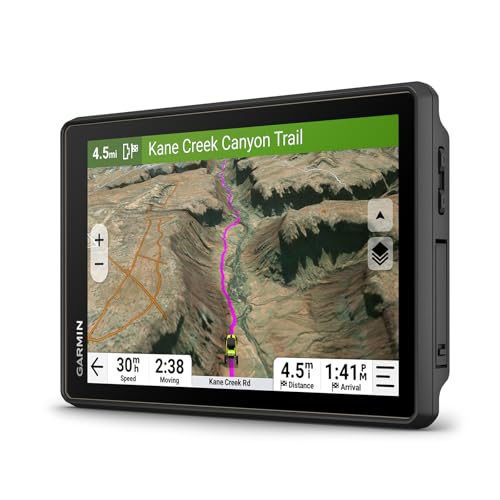


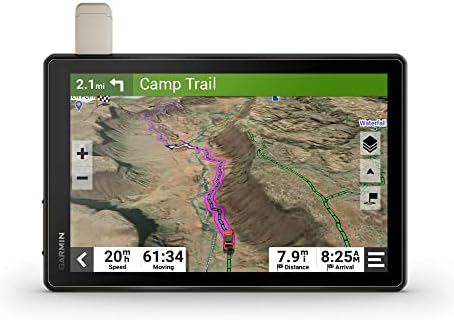


When it comes to Garmin Tread 2 vs Trail Tech Voyager Pro 4 for off road overlanding, getting the right details matters. Garmin Tread 2 SxS Edition 2026, Trail Tech Voyager Pro 4 2026, Baja Designs S8 Fused Aux Bus
The Mechanical Trail Failure:
Why Standard UTV Navigation Systems Destruct in Extreme Environments
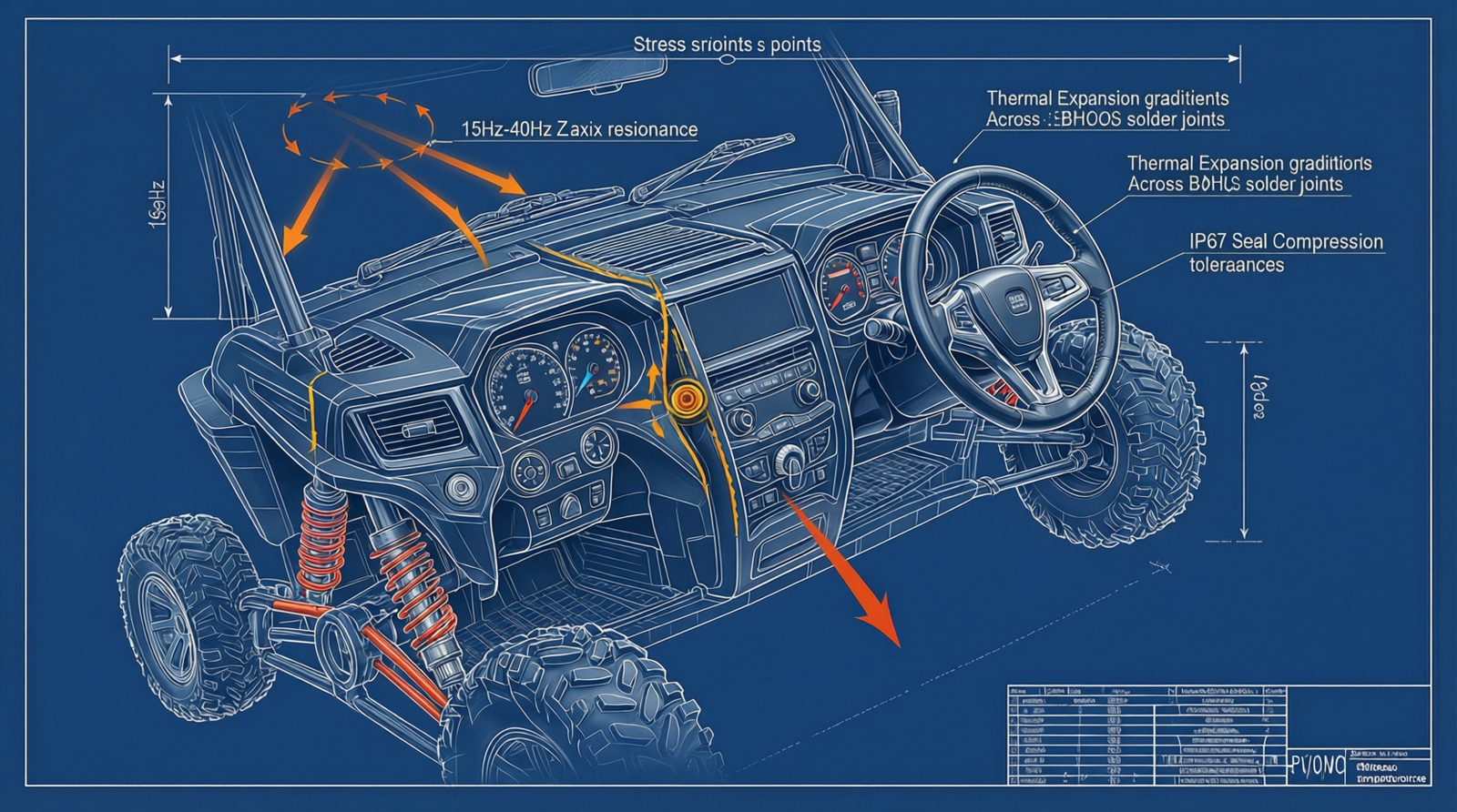
High-Frequency Resonance & ITO Delamination: Surviving 15Hz-40Hz Z-Axis Washboard Impacts
Long-travel suspension platforms generate violent 15Hz-40Hz vertical oscillations when traversing washboard surfaces, creating resonant frequencies that exceed standard capacitive display tolerances. The micro-fractures propagate rapidly through the indium tin oxide conductive layer under sustained harmonic stress.
Ghost touching manifests as phantom inputs, while ribbon cable fatigue eventually severs internal connections, leaving you with an unresponsive interface precisely when route correction is critical.
Thermometer ical Fatigue of BGA Solder Joints Under 45°C+ Desert Radiant Heat
Ambient temperatures exceeding 45°C combine with exhaust radiant output to induce severe thermal expansion across heterogeneous circuit board materials. The coefficient mismatch generates shear stress that progressively degrades ball grid array solder integrity.
Cold joints form unpredictably, triggering random hardware reboots mid-section when navigating technical rock gardens or steep inclines.
Multipath Error in Canyons: Mitigating 50-150m L1 Signal Drift on Cliff Edges
Single-frequency L1 signals reflect off sandstone formations and dense canopy layers, creating multipath interference that corrupts satellite triangulation algorithms. Unmitigated signal bounce introduces positional drift ranging from 50 to 150 meters horizontally.
Your track dot jumps laterally across the display, forcing dangerous cliff-edge misjudgments on narrow shelf roads where margin for error does not exist.
Silt Ingress (<0.05mm) and the Death of Non-IP67/IP68 Physical Interfaces
Ultra-fine particulate matter smaller than 0.05mm behaves as an abrasive fluid under pressure, penetrating micro-gaps around buttons, speakers, and charging ports. Without certified sealing standards, this dust bridges contact pins and mechanically jams actuator components.
Check out our off-road collection Amazon products
Physical interfaces seize permanently, causing short circuits that render the unit dead despite intact internal circuitry.
The 2026 Core Gear Architecture: Garmin Tread 2 SxS vs. Trail Tech Voyager Pro 4 Spec Breakdown
| Feature Category | Garmin Tread 2 SxS Edition | Trail Tech Voyager Pro 4 | GNSS & Routing Logic | Dual-frequency L1+L5 tracking across GPS, GLONASS, Galileo, BeiDou with Off-Road Routing algorithms; prone to algorithmic dead-end routing on unmaintained logging roads. | Optimized GLONASS/Galileo dual-frequency setup relying on verified GPX breadcrumb trails; prioritizes proven tire tracks over algorithmic shortcuts. | Display & Interface Survivability | 5.5″ or 7″ 1200-nit capacitive touchscreen with physical button redundancy; performance degrades under heavy mud saturation or wet glove operation. | 4.3″ or 5″ 1000-nit TFT panel controlled exclusively by tactile-feedback physical knobs; enables flawless blind-operation in thick mud and heavy protective gear. | Ecosystem Integration | Seamless pairing with inReach Mini 3 Plus for Satellite SOS, 2-way SMS, and Group Ride location sharing; prioritizes external communication networks. | Hardwired OBD/CVT sensor integration displaying real-time coolant temperature, CVT heat, RPM, and system voltage; prioritizes mechanical heartbeat monitoring. | Processing & Storage | 8-core processor with 8GB internal storage plus MicroSD expansion for TopoActive mapping and BirdsEye imagery; optimized for complex terrain rendering. | 4-core processor dedicated to high-refresh-rate telemetry arrays with 16GB internal storage; ensures zero screen stutter during rapid gauge updates. |
|---|
The Technical Setup Blueprint: UTV-Specific Wiring, Mounting, and Torque Specifications
Universal Electrical Protocols: 14 AWG Stranded Copper, Heat Shrink Crimps, and Aux Bus Fusing
Recommended Insights From Our Guide Library:
- Garmin Tread vs Voyager Pro: Best UTV GPS for Honda Pioneer
- Expedition-Grade UTV Navigation: Engineering Reliability for Extreme Off-Road Telemetry – Pioneer Honda Lovers
- garmin tread vs voyager pro Archives – Pioneer Honda Lovers
- Mastering Off-Road Navigation: Engineering Resilience for Extended Trail Expeditions – Pioneer Honda Lovers
- garmin tread review Archives – Pioneer Honda Lovers
All power runs must utilize 14 AWG stranded pure copper conductors terminated with heat shrink crimp connectors. Inline fuses rated at 10A or 15A must be positioned within 3 inches of the positive terminal, or routed through a Baja Designs S8 Fused Aux Bus to contain potential short-circuit energy.
Scotch locks and electrical tape create moisture traps that accelerate green corrosion, eventually starving the navigation unit of stable voltage and causing intermittent dropout.
Eliminating Mount Weakness: CNC 6061-T6 Aluminum Bases with Vibration Isolators
Universal plastic brackets and standard ball-head mounts fail under sustained high-speed resonance, leading to rapid bearing wear and structural flex. Custom CNC-machined aluminum bases incorporating rubber-damped vibration isolators transfer high-frequency energy away from the chassis mounting points.
The display remains locked in position, preventing screen tearing and eliminating the risk of catastrophic projectile failure during high-impact maneuvers.
CVT Architecture Execution (Polaris RZR Pro R / Can-Am X3): M8 Tube Mounts, 120°C+ Heat Avoidance, and 6-8 ft-lbs Torque
Polaris platforms require M8 threaded dash hole utilization for secure tube mount attachment, while Can-Am models demand full dash pod replacement for proper unit embedding. Fiberglass wire sleeving must shield all harnesses, maintaining a strict 3-inch clearance from CVT intake and exhaust lines operating above 120°C.
Overtightening dash fasteners beyond 6-8 ft-lbs instantly fractures plastic mounting columns, while exposed wire insulation melts onto hot components, creating fire hazards and signal loss.
DCT Architecture Execution (Honda Pioneer 1000 / Talon): 12V 10A Relay Isolation, Custom CNC Dash Pods, and 8-10 ft-lbs Torque
Dual-clutch transmission control modules cannot tolerate parasitic voltage drops from auxiliary taps. Power must be sourced through a dedicated 12V 10A relay wired directly to the main battery, bypassing sensitive ECU and TCM circuits entirely.
Custom aluminum dash panels provide flat integration surfaces, while maintaining 8-10 ft-lbs on dash mounts and 5-7 ft-lbs on battery terminals prevents bolt shearing and ground strap loosening.
Check out our off-road collection Amazon products
Field Verdict & Operational ROI: Selecting the Right Navigation Stack for Your UTV Architecture
The Overlander’s ROI: Garmin Tread 2 for Route Planning and Satellite Comms
The Garmin Tread 2 SxS Edition 2026 delivers maximum operational return for expedition teams requiring dynamic topographical routing and continuous satellite uplink capabilities. Its 1200-nit panel and L1+L5 multi-constellation receiver ensure visibility and positioning accuracy across vast, unmarked wilderness corridors.
Expedition leaders gain access to life-saving SOS functionality and group tracking without carrying secondary communication devices, streamlining payload weight and reducing single-point failure risks.
The Hardcore Rock-Crawler’s ROI: Trail Tech Voyager Pro 4 for Telemetry and Breadcrumb Reliability
The Trail Tech Voyager Pro 4 2026 provides uncompromising reliability for technical terrain specialists who depend on mechanical diagnostics and proven trail data. Its tactile knob interface and high-refresh telemetry arrays eliminate input lag and visual clutter during precision crawling.
Drivers maintain complete situational awareness of engine vitals and verified path progression, allowing faster decision-making when navigating boulder fields, log crossings, and steep switchbacks.
The Cost of Failure: Why Investing in 2026 MIL-STD-810H/IP67 Hardware Prevents Stranded Recoveries
Community Reference & Authority Resources:
Mid-trail equipment failure triggers exponential recovery costs, including helicopter extraction fees, winch line damage, and extended exposure to hostile environmental conditions. Certified military-grade housing and sealed interfaces actively resist the mechanical and atmospheric forces that destroy consumer electronics.
Upgrading to validated 2026 architecture transforms navigation from a vulnerable accessory into a foundational safety system, guaranteeing operational continuity regardless of terrain severity or weather degradation.
🔍 Explore More: See all Wild Testing guides for Garmin Tread 2 vs Trail Tech Voyager Pro 4 for off road overlanding.
Check out our off-road collection Amazon products