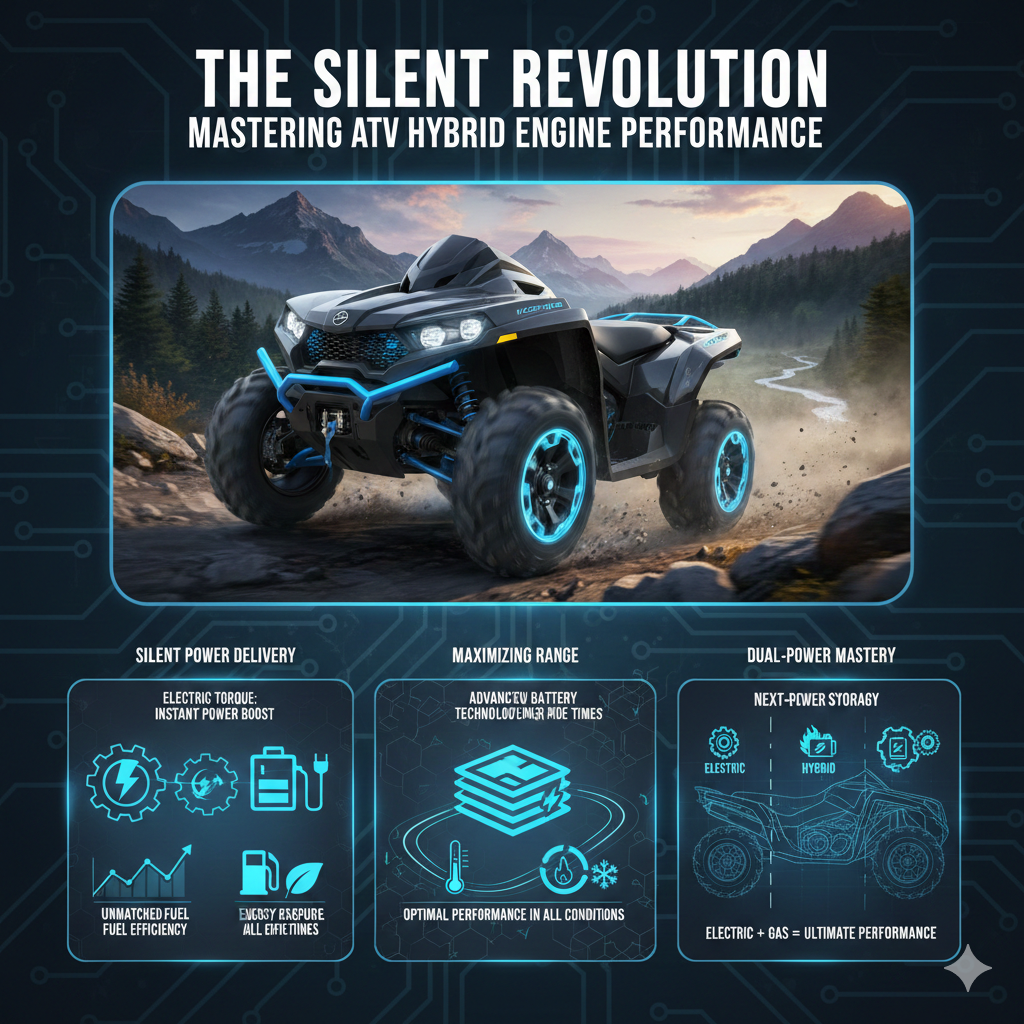





The off-road world is on the cusp of a major transformation, driven by the integration of electric power into traditional combustion engines.
ATV Hybrid Engine Performance is quickly becoming the benchmark for the next generation of power sports vehicles,
promising a blend of the internal combustion engine’s (ICE) range and the electric motor’s instant, silent torque.
This technology is not just about fuel efficiency;
it’s about fundamentally changing how ATVs and UTVs perform in the most demanding environments.
This comprehensive guide will explore the mechanics, advantages,
and challenges of hybrid power trains in the off-road segment,
focusing on how they deliver superior performance, especially in low-speed technical terrain.
Pillar 1: The Hybrid Advantage – Torque and Efficiency
Hybrid systems combine an ICE with an electric motor and a battery pack,
allowing the vehicle to operate in multiple modes,
each optimized for a different performance characteristic.
1. Instant Electric Torque
The most significant performance benefit of a hybrid system is the electric motor’s torque delivery.
Unlike an ICE, which must spool up to a certain RPM to reach peak torque,
an electric motor delivers 100% of its torque instantaneously from 0 RPM [1].
- Low-Speed Crawling: This instant torque is a game-changer for technical off-roading, rock crawling, and utility work. It provides precise, immediate power control, allowing the driver to modulate speed with incredible accuracy without relying on clutch slip or high engine revs.
- Boost Function: The electric motor can act as a power-assist, filling in the torque curve of the gasoline engine at low RPMs or providing a massive, instantaneous boost for quick acceleration or climbing steep grades [2].
2. Fuel Efficiency and Range Extension
Hybrid systems dramatically improve fuel economy,
which translates to a significantly extended range—a critical factor for remote off-road travel.
- Engine Optimization: The ICE can be downsized and tuned to operate primarily in its most efficient RPM range, with the electric motor handling the less efficient, high-torque demands.
- Silent Mode: Many hybrid concepts, such as the Toyota concept UTV, include a “Silent Mode” for low-speed operation, allowing for quiet travel into hunting or wildlife viewing areas, relying solely on electric power [3].
Pillar 2: The Technology Behind the Power
The performance of a hybrid ATV is defined by its architecture and its ability to manage energy.
3. Hybrid Architectures in Powersports
Hybrid systems are generally categorized into two main types,
both of which are being explored for off-road applications:
| Architecture | Power Flow | Battery Size | Off-Road Application |
|---|---|---|---|
| Parallel Hybrid | Both the ICE and electric motor can directly drive the wheels, either together or independently. | Smaller | Best for performance boost and regenerative braking on trails. |
| Series Hybrid | The ICE acts only as a generator to charge the battery; only the electric motor drives the wheels. | Larger | Best for maximum electric torque, quiet operation, and range extension. |
Parallel hybrids are often favored for power sports due to their smaller battery requirements and ability to use the ICE for sustained high-speed travel,
while the electric motor provides the low-end torque boost [4].
4. Regenerative Braking
Regenerative braking is a core component of hybrid efficiency.
When the driver brakes or coasts downhill, the electric motor reverses its function,
acting as a generator to convert the vehicle’s kinetic energy back into electrical energy, which is then stored in the battery [5].
- Off-Road Benefit: On long downhill descents, regenerative braking not only recharges the battery but also provides a smooth, controlled engine braking effect, reducing wear on the mechanical brakes and offering superior control on steep, technical terrain.
Pillar 3: Challenges and Future-Proofing
Integrating hybrid technology into the harsh off-road environment presents unique engineering challenges that manufacturers are actively addressing.
5. Battery Management in Extreme Conditions
The battery pack is the heart of the hybrid system and is highly sensitive to temperature and moisture.
- Thermal Management: Off-roading generates extreme heat from the engine and drivetrain, while the battery itself generates heat during discharge and charge cycles. Advanced liquid cooling systems are essential to keep the battery within its optimal operating temperature range, ensuring longevity and performance [6].
- Waterproofing and Durability: Hybrid components must be completely sealed and ruggedized to withstand deep water crossings, mud, and constant vibration. The battery housing must be impact-resistant to protect the cells from rocks and debris.
6. Weight and Complexity
Hybrid systems add weight and complexity due to the extra motor, battery pack, and control electronics.
- Weight Distribution: Engineers must strategically place the heavy battery pack low in the chassis to maintain a low center of gravity, which is crucial for UTV stability and handling on uneven terrain.
- Integration: The control unit must seamlessly manage the transition between ICE and electric power, ensuring a smooth, predictable power delivery that is critical for safe off-road driving.
The Performance Verdict
ATV Hybrid Engine Performance is delivering a superior off-road experience.
The combination of instant electric torque for technical crawling, the efficiency of regenerative braking,
and the extended range of the gasoline engine creates a machine that is more capable, more fuel-efficient, and quieter than its purely ICE-powered predecessors.
As battery technology advances and costs decrease, hybrid powertrains are poised to become the dominant force in the high-performance and utility off-road segments.