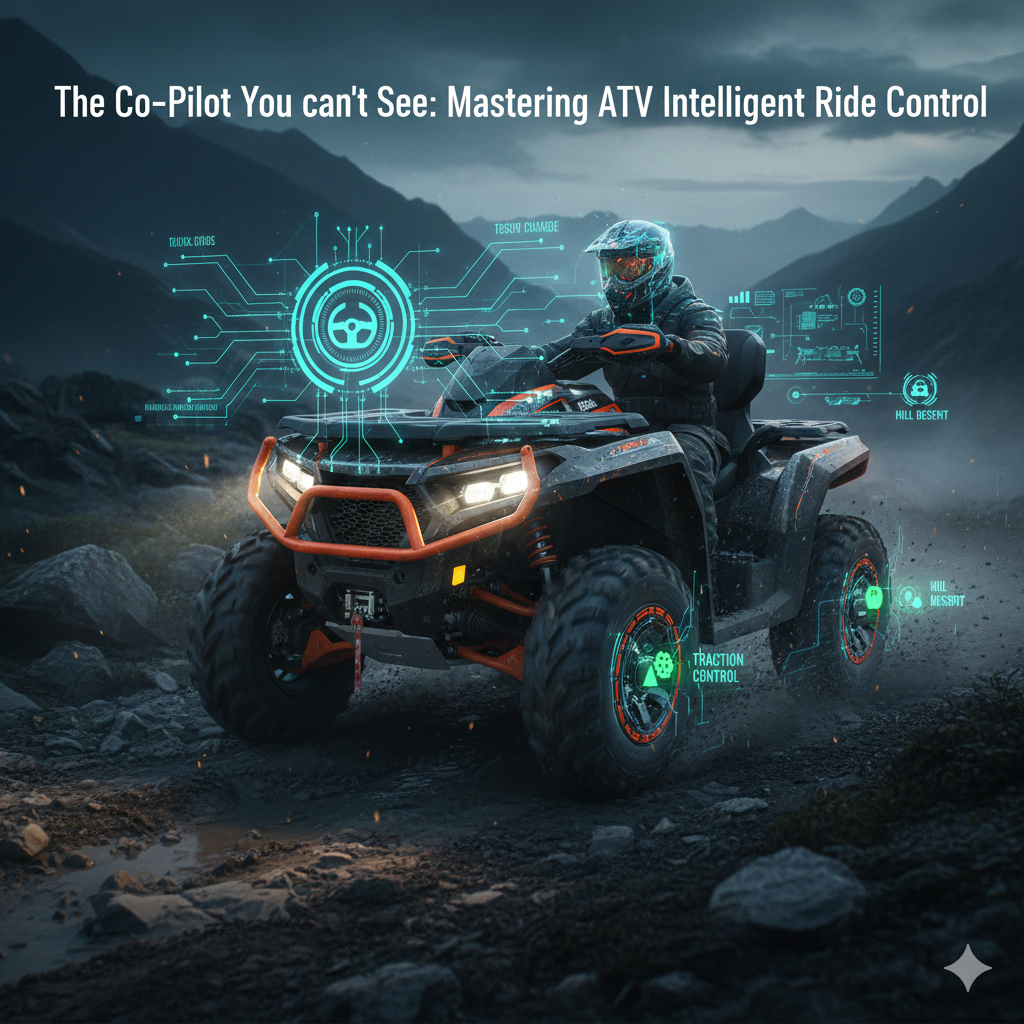
The modern All-Terrain Vehicle (ATV) and Utility Task Vehicle (UTV) are no longer simple mechanical beasts; they are sophisticated, computer-controlled machines. 🤖
The latest generation of off-road vehicles features ATV Intelligent Ride Control—an integrated suite of electronic systems that work in the background to enhance safety, improve handling, and maximize traction across the most challenging terrain.
These systems act as an invisible co-pilot, making split-second adjustments that even the most experienced driver would struggle to replicate. 💡
This comprehensive guide will explore the core components of intelligent ride control, detailing how technologies like Electronic Stability Control (ESC), Traction Control (TC), and Hill Descent Control (HDC) are managed by a central Electronic Control Unit (ECU) to deliver a safer, more confident, and ultimately more capable off-road experience.
The true mastery of off-road driving today lies not just in muscle, but in the intelligent electronics guiding the machine. 🤓
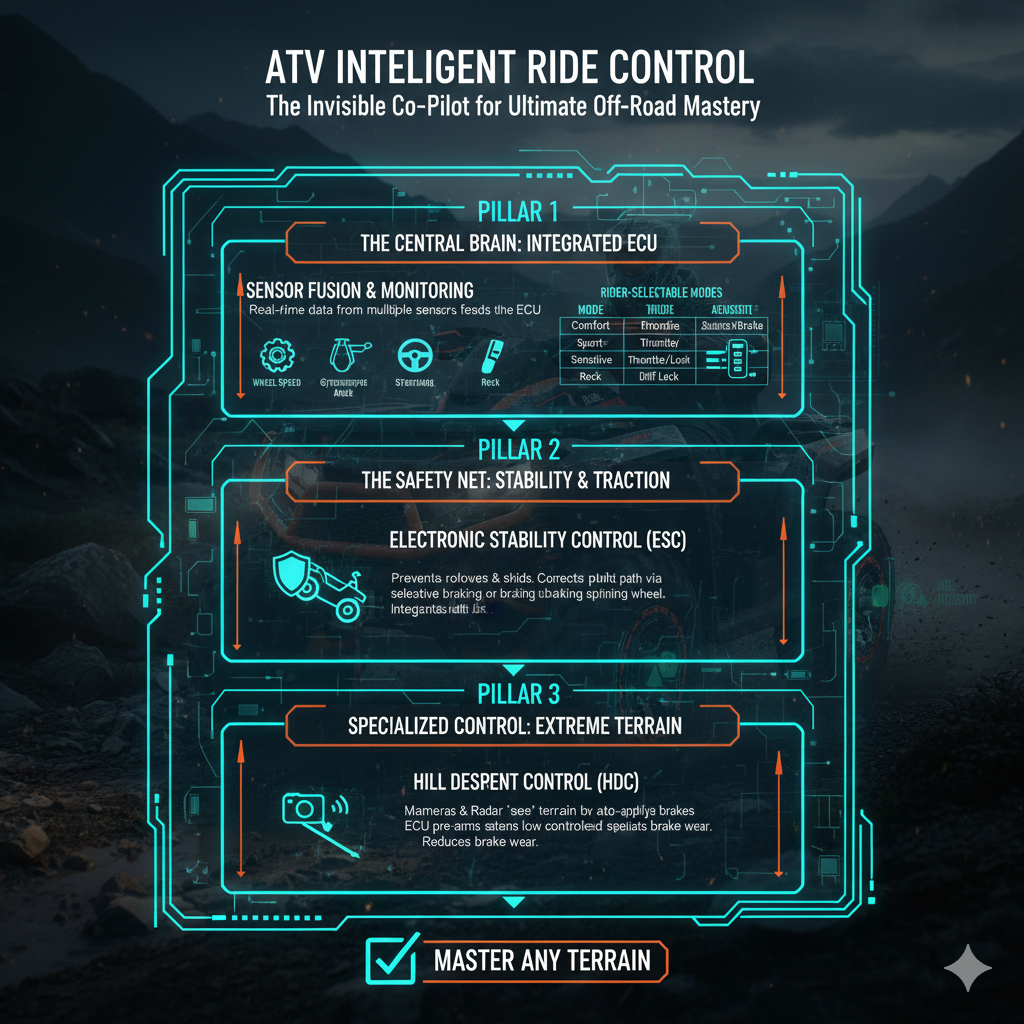
Pillar 1: The Central Brain – The Integrated ECU
At the heart of every intelligent ride control system is a powerful Electronic Control Unit (ECU).
This central computer monitors a vast array of sensors and coordinates the actions of all the electronic safety and performance features.
1. Sensor Fusion and Real-Time Monitoring
The ECU relies on a network of sensors to paint a real-time picture of the vehicle’s state and the driver’s intent.
Key inputs include:
- Wheel Speed Sensors: Measure the rotational speed of each wheel, which is crucial for detecting wheel spin (Traction Control) or wheel lock-up (Anti-lock Braking System).
- Lateral Accelerometer and Yaw Rate Sensor: Detects sideways slip and the vehicle’s rotation around its vertical axis, which are the primary indicators of a loss of control (Electronic Stability Control). Wikipedia. (n.d.). Electronic stability control.
- Steering Angle Sensor: Measures the driver’s intended direction.
- Throttle and Brake Pedal Position: Measures the driver’s input for acceleration and deceleration.
The ECU processes this data hundreds of times per second, allowing it to intervene with lightning speed when a critical situation is detected. 📌
2. Rider-Selectable Modes
Intelligent ride control systems often feature multiple, rider-selectable modes that recalibrate the ECU’s parameters to suit the terrain and driving style.
These modes fundamentally change how the vehicle behaves by altering throttle response, power delivery, and the sensitivity of the electronic aids.
Can-Am Off-Road. (n.d.). What are the different Driving Modes?.
| Ride Mode | ECU Adjustments | Ideal Terrain |
|---|---|---|
| Comfort/Trail | Softer throttle response, higher TC/ESC intervention threshold, plush suspension (if equipped). | General trail riding, long distances, utility work. |
| Sport/Baja | Aggressive throttle map, lower TC/ESC intervention threshold, firmer suspension. | High-speed open desert, dune riding. |
| Rock/Crawl | Extremely sensitive throttle for low-speed control, maximum torque delivery, full differential lock (if equipped). | Technical rock crawling, steep ascents/descents. |
Pillar 2: The Safety Net – Stability and Traction Control
The most critical functions of ATV Intelligent Ride Control are the systems designed to prevent loss of control and maximize traction. 🚧
As the old off-roading adage goes, “Speed is fine, but control is better.”
3. Electronic Stability Control (ESC)
ESC is a life-saving technology that works to prevent rollovers and skids, particularly in high-speed maneuvers or on uneven terrain.
How it Works:
- When the ECU detects a discrepancy between the driver’s intended path (from the steering angle sensor) and the vehicle’s actual path (from the yaw rate and lateral accelerometer), the ESC system intervenes.
- It selectively applies the brakes to individual wheels and/or reduces engine power to bring the vehicle back in line. Innova. (2024). What is Electronic Stability Control?.
Off-Road Benefit:
- On loose surfaces, ESC is invaluable for correcting oversteer (rear end sliding out) or understeer (front end pushing wide), offering enhanced stability and rider confidence.
4. Traction Control (TC)
Traction Control is designed to prevent wheel spin, ensuring that power is always delivered to the wheel with the most grip. ⛰️
Traction is the foundation of off-road capability; TC ensures that foundation remains solid even on slippery ground.
How it Works:
- The ECU monitors the wheel speed sensors. If one wheel is spinning significantly faster than the others, the TC system reduces engine torque or applies the brake to the spinning wheel.
- This forces the power to be transferred to the wheels that still have traction, maximizing forward momentum. CFMOTO. (2025). Innovative Technology in ATVs & UTVs: What’s New.
Integration with Differential Locks:
- Advanced systems like Can-Am’s Smart-Lok or Polaris’s electronic differential locks integrate seamlessly with TC.
- These systems can automatically engage or disengage the differential lock based on the terrain and the TC system’s input, ensuring the perfect balance of steering effort and traction. Can-Am Off-Road. (n.d.). Rider lockable technology Visco-4Lok.
Pillar 3: Specialized Control for Extreme Terrain
Intelligent ride control extends beyond basic stability to provide specialized assistance for the most challenging off-road obstacles.
“The machine should think about the traction, so the rider can think about the line.”
5. Hill Descent Control (HDC)
HDC is a system that automatically manages the vehicle’s speed on steep downhill grades, allowing the driver to focus entirely on steering.
How it Works:
- Once activated, the system uses the ABS sensors and the ECU to automatically apply and release the brakes to maintain a very slow, controlled speed (typically 2-5 mph).
- This prevents the wheels from locking up and the vehicle from running away, which is a common hazard on steep, loose slopes.
- HDC often works in conjunction with the vehicle’s engine braking system, using the engine’s compression to slow the vehicle, thereby reducing wear on the mechanical brakes.
6. The Future of Intelligent Control
The next frontier for ATV Intelligent Ride Control is the integration of predictive technology. 🔮
By using cameras and radar, the ECU will be able to “see” the terrain ahead and pre-arm the stability and traction systems, or even adjust the electronic suspension, before the vehicle encounters the obstacle.
Systems like Polaris’s DYNAMIX Smart Suspension already adapt damping in real-time based on driver input and vehicle dynamics. This proactive approach is the ultimate form of intelligent control.
This level of proactive control will make off-roading safer, faster, and more accessible to riders of all skill levels.
The rise of ATV Intelligent Ride Control marks a paradigm shift in off-road technology.
It transforms the challenge of conquering difficult terrain from a purely physical fight against the machine into a nuanced partnership with a sophisticated electronic co-pilot.
By mastering the use of these integrated systems—knowing when to engage a specific ride mode, understanding how ESC keeps the vehicle stable, and appreciating the fine adjustments of TC—riders gain confidence and capability previously reserved only for professional drivers.
Embrace the co-pilot you can’t see, and redefine what’s possible on the trail.