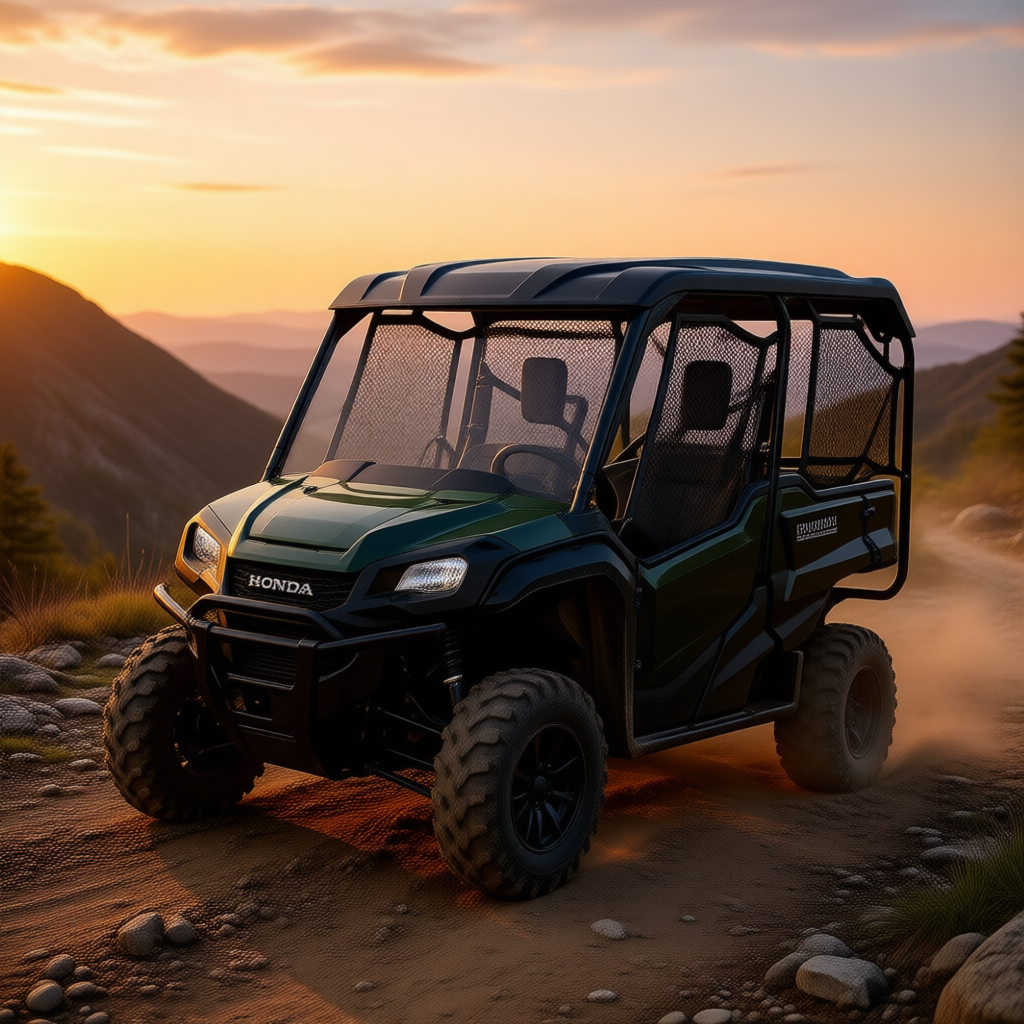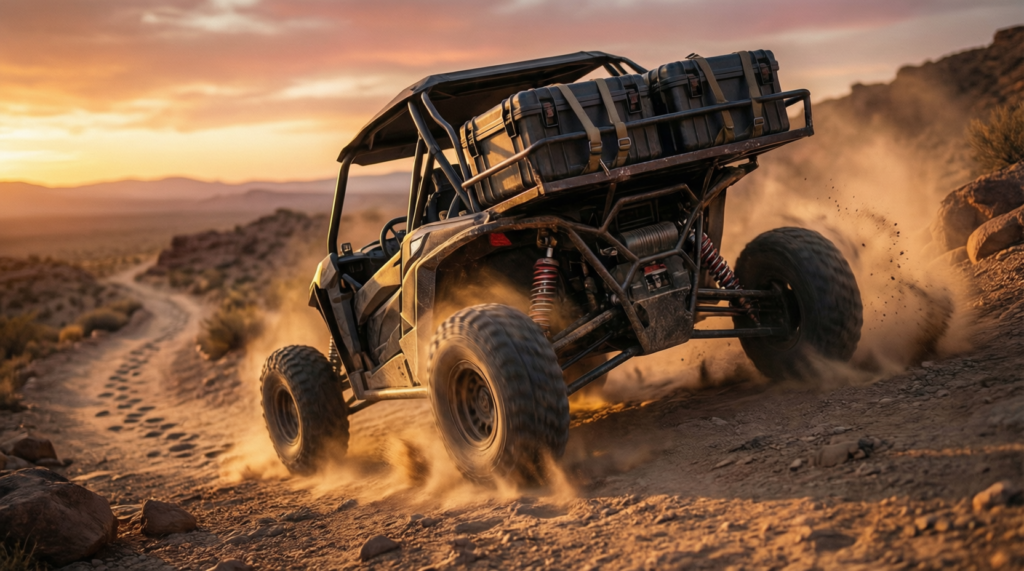

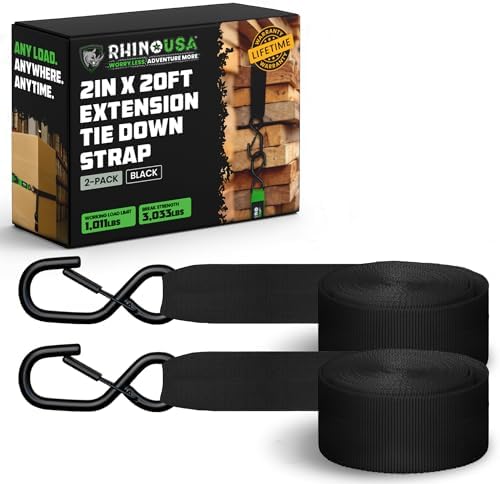


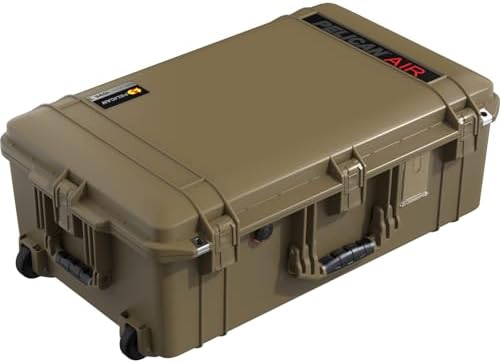


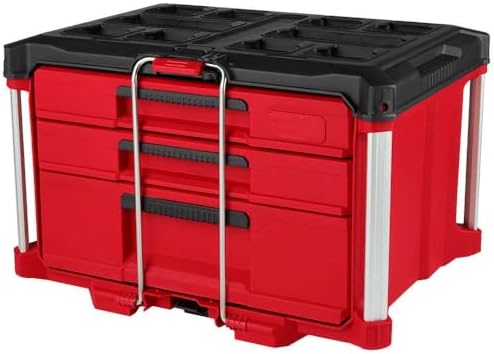
When it comes to gasket rule for packing long distance UTV trips, getting the right details matters. Milwaukee Packout 2026 Gen 3 Modular System, Pelican Elite 1605 Air Case, Rhino USA 2026 Ratchet Strap Kit
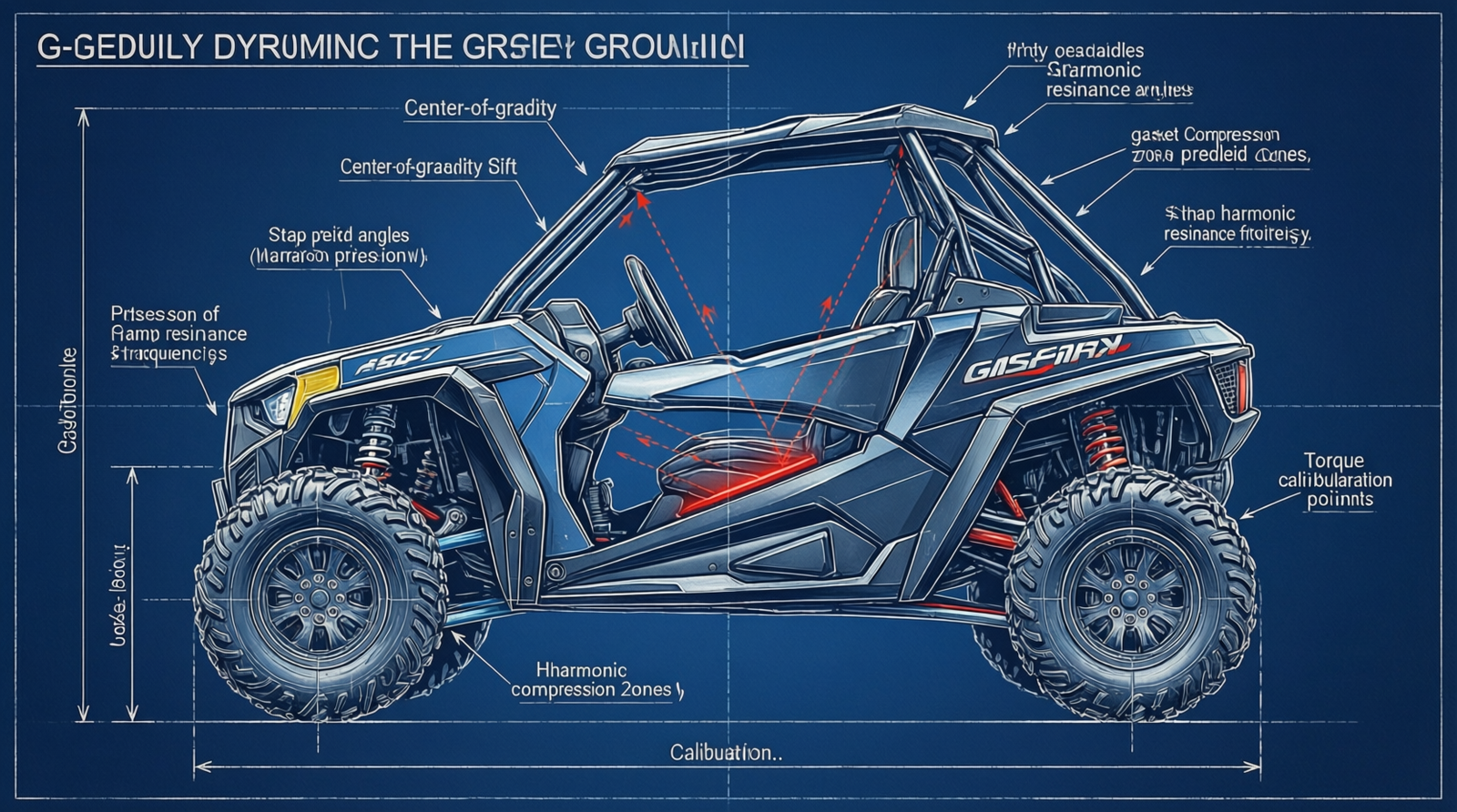
You will learn how to engineer a trail-ready cargo system that survives sustained washboard frequencies, lateral G-loads, and fine particulate ingress. The problem is predictable: soft storage and cam buckles fail under real-world trail dynamics. The solution is rigid, gasket-sealed architecture paired with positive-lock preload management. This guide maps the exact physics of gear failure, deploys the hardware stack that neutralizes it, and delivers the torque-calibrated setup protocols required for safe, long-range deployment.
The Gasket Rule for Packing Long-Distance UTV Trips: Hard-Case Architecture, Load
Dynamics & Trail Specs
The Mechanical Failure Sequence: Why Soft Storage & Cam Buckles Fail Under Trail Load
Zipper/Seam Cyclic Fatigue & Particulate Ingress Mechanics
Standard YKK #5/#8 coil zippers experience abrasive wear from silica dust under 10–25Hz trail vibration. That fine dust measures under 75 microns and acts as a mechanical lapping compound. It deforms polymer teeth and jams sliders after roughly 300–500 dynamic load cycles.
You will feel the zipper stick halfway through a camp setup. Capillary wicking through fabric pores then pulls moisture and silt into supposedly dry bags during rain or mud crossings. The gasket rule for packing long distance UTV trips exists because fabric and zippers cannot seal against hydrostatic pressure. Only a compressed rubber barrier stops the ingress.
Center of Mass Vector Shift & Roll Threshold Breach
Soft storage compresses and migrates under 0.8–1.2G dynamic cornering loads. Gear shifts upward and outward by 3–6 inches. Your UTV operates on a narrow 60–64 inch track width with a 28–32 inch static center of gravity height. That migration reduces your rollover threshold angle by 15–22%.
You will feel the machine get tippy on off-camber trails. The suspension loses effective travel because the outer side unloads prematurely. High-mounted weight directly compromises your roll stability.
Dynamic Strap Creep & Anchor Point Shear Failure
Polyester webbing on soft bags elongates 5–8% under sustained trail vibration. Non-locking cam buckles allow incremental slip every time the rig hits a bump. Dynamic shock loads multiply to 2.5–3.0x the static weight of your gear. That force transfers directly to factory M8/M10 Grade 8.8 bed bolts rated for 40–60 kN static shear. Repeated micro-impacts exceed the bolt yield strength.
You will eventually find stripped threads or cracked plastic bed anchor bosses. Cam straps simply cannot hold a rigid load under washboard resonance.
Bed Flex Resonance & Load Decoupling Harmonics
Factory composite and plastic UTV beds deflect 1.5–3.0mm under load. At 12–18Hz washboard frequencies, soft bags decouple from the chassis and bounce independently. Unsecured gear slams into bed walls and transfers concentrated point loads.
You will hear and feel the plastic flex like a trampoline. Over time, those harmonic impacts crack OEM bed panels and warp crossmember welds. Independent bouncing destroys structural integrity.
The Core Gear Architecture: 2026 Hard-Case & Tie-Down Stack
Primary Gasket-Sealed Storage Systems (IP-Rated Enclosures)
Check out our off-road collection Amazon products
| System | IP Rating | Shell Material | Dynamic Load Rating | Sealing Mechanism | Milwaukee Packout 2026 Gen 3 Modular System | IP54 | 5052-H32 Marine Aluminum Latch / Polymer Body | 250 lbs | 0.5mm EPDM O-Ring | Pelican Elite 1605 Air Case | IP67 | 1/4″ ABS Copolymer | 250 lbs | 0.5mm EPDM O-Ring |
|---|
Both systems utilize a 0.5mm EPDM perimeter O-ring gasket that compresses into a rigid channel. The field-replaceable gasket and latch architecture means you fix a broken seal in minutes instead of replacing the entire box.
You get a sealed environment that ignores mud, rain, and dust storms.
Positive-Lock Tie-Downs & Static Preload Management
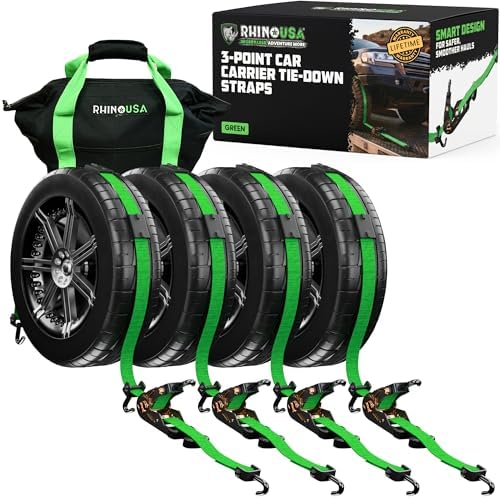
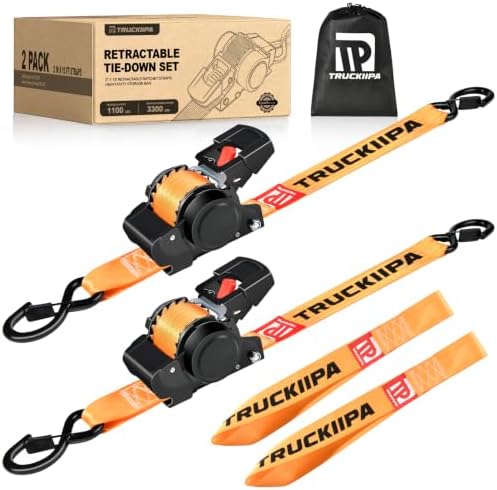
The Rhino USA 2026 Ratchet Strap Kit uses 1.5 inch webbing rated at 3,300 lb Working Load Limit and 10,000 lb break strength. The polyester weave exhibits less than 3% elongation at full WLL. A zinc-plated ratchet pawl with an anti-backlash spring locks the tension in place.
Bungee cords lose 30–40% tension within 50 miles of washboard travel. Ratchets maintain constant compression. You will feel zero gear migration because the strap refuses to stretch or slip under vibration.
Navigation & Satellite Comms Integration
The Garmin Tread 2 SxS Edition delivers a 7 inch sunlight-readable display with an IPX7 rating. It connects via a direct SxS wiring harness and ships with preloaded ONX Offroad maps. The Garmin inReach Mini 3 Plus runs for 20 days on 10-minute tracking intervals. It carries an IPX7 rating and a dedicated SOS button. The ZOLEO 3 routes through the Global Iridium network with 20-day standby, Bluetooth 5.2 LE, and an IP67 enclosure.
Your screen stays visible in direct glare. Your satellite link works in deep canyons where cell service dies. You maintain routing accuracy and a guaranteed emergency lifeline.
LiFePO4 Power & Compressor Cooling Optimization
The Dometic CFX3 45W offers 40 liters of storage on 12V/24V DC. It carries an IPX4 rating, uses a 12mm compressor, and operates below a 45dB noise floor. The unit is LiFePO4 optimized for modern power architectures. The Jackery Explorer 2000 Plus delivers 2042Wh of LiFePO4 chemistry with a 3000W surge capacity. The IP54 enclosure survives 3000+ cycles to 80% Depth of Discharge.
Your fridge runs quietly and draws minimal current. Your power station handles high-draw tools and survives thousands of deep cycles without degrading. You keep food cold and electronics charged without killing your starter battery.
The Technical Setup Blueprint: Zoning, Torque & Architecture-Specific Protocols
Recommended Insights From Our Guide Library:
- Ultimate Guide to Gasket Sealed UTV Cargo Enclosures – Pioneer Honda Lovers
- Leave No Trace UTV practices – Pioneer Honda Lovers
- UTV accessories Archives – Pioneer Honda Lovers
- Summer UTV Camping: Your Essential Gear List for Epic Adventures – Pioneer Honda Lovers
- Trail-Ready Gear Protection for Your Side-by-Side Adventures – Pioneer Honda Lovers
Weight Distribution & CoG Zoning Protocol
Place heavy items like tools, fuel, coolers, and recovery gear at bed floor level, centered directly between the wheel wells. Route lightweight, high-volume gear like tents, sleeping pads, and clothing to roof racks or elevated positions. Aftermarket steel or aluminum rack systems from Dragonfire or SuperATV must anchor directly to the chassis subframe.
You keep the center of gravity low to maintain predictable cornering. You bypass the weak plastic bed entirely by bolting racks to the steel frame. Your suspension works efficiently because weight stays inside the wheelbase.
CVT Architecture Trailside Protocol (Polaris RZR / Can-Am X3 / Maverick)
Carry T30/T40 Torx bits for outer covers and 8mm hex keys for inner fasteners. Pack a primary clutch spring compressor/spreader, a 1.5 inch belt caliper, and a clutch alignment gauge. Torque clutch cover bolts to 10–12 ft-lbs. Use the spreader to compress the primary spring, slide the worn belt off the secondary sheave, install the new belt, and verify tracking. Torque the primary retaining nut to 150–180 ft-lbs using the OEM holding tool. Set secondary preload to 18–22 ft-lbs.
You follow the exact sequence to avoid warping the clutch assembly. Proper tension and tracking prevent mid-trail power loss and overheating.
DCT Architecture Constraints & Electrical Safeguards (Honda Pioneer / Talon)
Sealed hydraulic dual-clutch actuation eliminates trailside belt or clutch intervention. Focus your kit on 30A/40A main relay fuses, shift solenoid harness connectors, ECU limp-mode reset procedures, and a 1.1 bar radiator cap pressure relief valve. Steel or composite hybrid beds require 10mm or 12mm bolt patterns anchored to the chassis subframe. Respect the 300+ lb distributed dynamic load rating.
You protect the electrical and cooling systems instead of attempting mechanical transmission repairs. Anchoring heavy loads to the frame prevents plastic bed failure under heavy vibration.
Universal Fastener & Preload Calibration Matrix
Check out our off-road collection Amazon products
| Component / Fastener | Size / Spec | Target Torque / Preload | Operational Limit | Strap Anchors (Bed Bosses) | M8 / M10 | 15–20 ft-lbs | Max 1/3 Break Strength | Bed Anchors | 10mm / 12mm | 25–35 ft-lbs | Grade 8.8 Minimum | Roof Mounts | Standard | 25–30 ft-lbs | Chassis Subframe Only | Electrical Lugs | Standard | 15–20 in-lbs | Anti-Corrosion Grease | Hard Case Static Preload | Per Unit | 200–300 lbs | Eliminates Harmonic Bounce |
|---|
Carry a baseline socket set of 8mm, 10mm, 12mm, 13mm, and 15mm. Add T25, T30, and T40 Torx bits.
You prevent stripped threads and anchor fractures by hitting exact torque targets. Proper preload locks the cargo to the frame so nothing moves independently.
Field Verdict & Operational ROI: The Cost-to-Failure Equation
OEM vs Aftermarket Cost-to-Failure Analysis
Manufacturer-branded storage carries a 30–50% markup penalty. Universal modular systems deliver superior IP54/IP67 ratings and field-serviceable hardware. OEM fitment restricts cross-platform interoperability and relies on proprietary sealing that degrades quickly.
You stop paying a premium for model-specific plastic that fails faster than universal alternatives. Aftermarket hard cases bolt to any rig, seal tighter, and let you replace worn latches or gaskets cheaply.
Long-Distance Durability & Risk Mitigation ROI
Gasket-sealed hard cases paired with ratchet preloads function as mandatory engineering controls. They prevent $2k+ bed and crossmember repairs, mid-trip zipper or cam buckle failures, and suspension geometry compromise. Guaranteed comms and power uptime via LiFePO4 chemistry and IPX7/IP67 satellite routing keeps expeditions moving in remote terrain.
You treat proper cargo architecture as insurance against catastrophic trailside breakdowns. The upfront hardware cost pays for itself the moment a factory plastic bed cracks or a soft bag floods.
Final Implementation Checklist & Compliance Verification
Verify gasket compression on every enclosure before departure. Confirm 200–300 lb static preload across all hard cases. Audit every bolt torque against the calibration matrix. Validate CoG zoning with heavy items low and centered. Update all navigation and satellite firmware and map packages.
Community Reference & Authority Resources:
You execute this matrix to lock in the gasket rule for packing long distance UTV trips and eliminate preventable mechanical failures. Compliance turns theoretical specs into predictable trail performance.
You now possess the exact engineering blueprint to transform a chaotic cargo bed into a rigid, trail-hardened system. We mapped the physics of soft storage failure, deployed the IP-rated hardware stack, and calibrated every bolt and strap to factory tolerances. The trail does not forgive loose gear or compromised seals. Lock your weight low, seal your gear tight, and torque every anchor to spec. Your rig will handle predictably, your equipment will survive the miles, and your expedition will finish exactly where it started.
🔍 Explore More: See all Wild Testing guides for gasket rule for packing long distance UTV trips.
Check out our off-road collection Amazon products