


Kubota RTV vs Kawasaki Mule Diesel: The Ultimate Diesel UTV Showdown
When the job demands relentless power, unwavering durability, and the fuel efficiency only a diesel engine can provide, the choice often comes down to two titans: the Kubota RTV and the Kawasaki Mule Diesel. These aren’t just recreational side-by-sides; they are purpose-built, commercial-grade workhorses designed to run all day, every day. The debate of kubota rtv vs kawasaki mule diesel is a serious one for farmers, contractors, and large property owners.
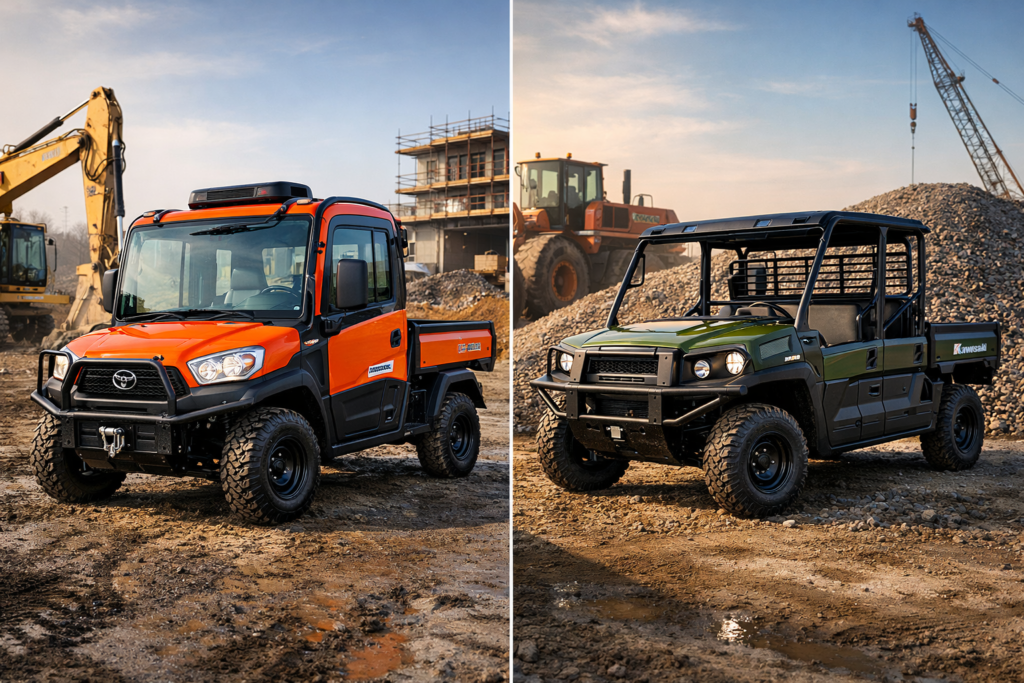
I’ve seen both of these machines put through the wringer on construction sites and sprawling ranches. The Kubota RTV, with its hydrostatic transmission and heavy-duty build, feels like a compact tractor. The Kawasaki Mule Diesel, on the other hand, leans on its legendary simplicity and massive cargo capacity. Your choice will depend entirely on what you prioritize: hydraulic power and control, or raw hauling space and proven reliability.
 Two commercial heavyweights ready for the toughest jobs.
Engine and Transmission: Diesel Power and Control
Both UTVs utilize reliable, liquid-cooled diesel engines, but their approach to power delivery is fundamentally different. The Kubota RTV, particularly the RTV-X series (like the X1140 or X1100), is powered by a Kubota-built diesel engine, often a 3-cylinder, 24.8 HP unit. The key difference is the transmission: Kubota uses its proprietary Variable Hydro Transmission (VHT-X).
The VHT-X offers smooth, consistent power delivery with excellent engine braking, making it exceptional for controlled descents and heavy-duty towing. It feels more like driving a tractor than a UTV. The Kawasaki Mule Diesel (such as the PRO-DX) typically uses an 812cc 3-cylinder diesel engine and pairs it with a traditional Continuously Variable Transmission (CVT). This CVT is simple, reliable, and allows the Mule to achieve slightly higher top speeds, but it lacks the precise control and engine braking of the Kubota’s hydrostatic system.
For jobs requiring fine-tuned speed control, like spraying or maneuvering in tight spaces, the Kubota RTV’s VHT-X is a clear advantage. For those who prefer a more traditional, faster-engaging drive, the Kawasaki Mule’s CVT is a time-tested, reliable choice.
Hydraulic Systems and Attachments: The Tractor Factor
This is where the Kubota RTV truly separates itself in the kubota rtv vs kawasaki mule diesel debate. Kubota has engineered the RTV to be a true multi-tool, often offering a standard hydraulic bed dump and, on some models, a factory-installed hydraulic three-point hitch. This feature allows the RTV to use a range of tractor implements like rakes, blades, and small plows, turning it into a miniature tractor [1].
The Kawasaki Mule PRO-DX, while capable of towing and hauling, is primarily a transport and cargo vehicle. Its bed dump is typically manual or electric/hydraulic as an option, but it does not offer the integrated hydraulic power take-off (PTO) capabilities of the Kubota. If your work involves frequently lifting heavy loads, operating hydraulic implements, or needing precise control over the dump bed, the Kubota RTV’s superior hydraulic system is a game-changer.
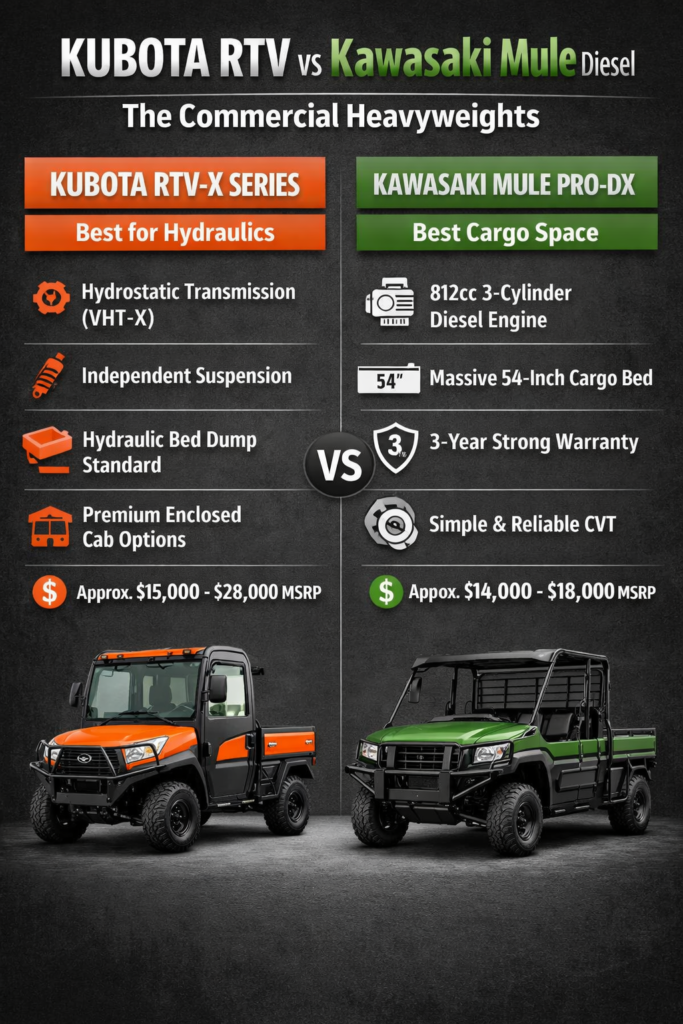 Key specifications and features of the diesel workhorses.
Cargo and Capacity: Hauling vs. Working
Both machines are built to haul, but their cargo beds reflect their different design philosophies. The Kawasaki Mule PRO-DX is renowned for its massive, steel cargo bed, often measuring around 54 inches long. This huge bed is ideal for carrying full-sized pallets, large feed bags, or a significant amount of construction material. The Mule’s design prioritizes sheer volume and ease of loading.
The Kubota RTV-X series also offers a robust steel cargo bed with a comparable 1,100-pound capacity, but its overall bed size is slightly smaller than the Mule’s. However, the Kubota often includes a standard hydraulic lift for the bed, which is a massive convenience when dumping heavy loads. The Kubota’s focus is on the function of the bed (easy dumping, hydraulic power), while the Mule’s focus is on the size of the bed.
When comparing the **kubota rtv vs kawasaki mule diesel** on capacity, both have excellent towing (around 1,300 lbs) and payload ratings. The choice here is simple: if you need the biggest possible bed, go Mule; if you need the convenience of hydraulic dumping, go Kubota.
Specifications Comparison Table (Typical Diesel Models)
| Feature | Kubota RTV-X Series | Kawasaki Mule PRO-DX |
|---|---|---|
| Engine Type | Kubota Diesel (24.8 HP) | Kawasaki Diesel (812cc) |
| Transmission | Variable Hydro Transmission (VHT-X) | CVT (Continuously Variable Transmission) |
| Cargo Capacity | ~1,100 lbs | ~1,000 lbs |
| Towing Capacity | ~1,300 lbs | ~1,000 lbs |
| Hydraulic Bed Dump | Standard (on most models) | Optional/Accessory |
| Top Speed | ~25 mph (Governed) | ~30 mph |
Durability, Reliability, and Cost: The Long-Term View
Both Kubota and Kawasaki have stellar reputations for building tough, reliable equipment. The Mule’s reputation for longevity is legendary, backed by a strong 3-year warranty. Its simpler CVT system often translates to lower maintenance costs over the long run. The Mule is built to be a no-frills, get-it-done machine that will last for decades.
The Kubota RTV, however, is often described as “overbuilt.” Its heavy-duty construction and hydrostatic transmission are designed for commercial use and heavy abuse. While the RTV is incredibly durable, the complexity of the hydrostatic system can sometimes lead to higher repair costs if issues arise [2]. Furthermore, the RTV’s top speed is often governed to around 25 mph, a trade-off for its superior low-speed control, which can be a drawback if you need to cover long distances quickly.
In terms of price, the Kawasaki Mule PRO-DX is generally the more budget-friendly option, with models starting around $14,000 to $18,000. The Kubota RTV-X series has a wider price range, especially when factoring in the fully enclosed, air-conditioned cab options, which can push the price well over $25,000 [3].
“The Kubota RTV is essentially a small, high-speed tractor, perfect for implement work and precise control. The Kawasaki Mule Diesel is the ultimate, no-nonsense hauling machine with a focus on simple, long-term reliability.” – A common sentiment among diesel UTV owners.
The Final Verdict: Which Diesel UTV is Right for You?
The choice between the kubota rtv vs kawasaki mule diesel is a decision between two excellent, yet distinct, philosophies of utility. Both will serve you well, but one is likely a better fit for your specific needs.
Choose the Kubota RTV Diesel if:
- You need superior hydraulic power for operating implements (like a 3-point hitch) or for precise control over the hydraulic bed dump.
- You prioritize low-speed control and engine braking for working on steep terrain or in very tight, controlled environments.
- You are looking for the most robust, tractor-like build** and are willing to pay a premium for features like a factory-installed, climate-controlled cab.
Choose the Kawasaki Mule Diesel if:
- Your primary need is **raw hauling and transport** over long distances, and you need the largest possible cargo bed.
- You prioritize a **lower initial cost** and the simplicity of a traditional CVT for potentially lower long-term maintenance.
- You value the **legendary, decades-long reputation** of the Mule for simple, no-frills, and unwavering reliability.
Ultimately, both are commercial-grade machines that will outlast their gasoline counterparts. Assess your needs: do you need a compact tractor (Kubota) or a heavy-duty pickup truck (Mule)? That answer will guide your decision.
Best regards,
Recommended Resources
- Video: Kawasaki Mule vs. Kubota RTV X1140 Comparison and 3,000 mile Review (20:45) – A long-term, real-world comparison of the two machines by a user who owns both.
- Video: Kubota RTV X1100C vs. Kawasaki 3010 trans diesel 8 month Review (15:30) – A detailed review focusing on the enclosed cab and diesel performance.
- Outbound Link: TractorByNet Forum Discussion: RTV vs Mule – Real-world user opinions on maintenance and long-term costs.
- Outbound Link: Wickham Tractor Co. – Kubota RTV vs Kawasaki Mule – A dealer’s perspective on the key differences.
References
- NC Gun Owners: Kubota RTV VS Kawasaki Mule
- Yesterday’s Tractors: Kawasaki Mule vs Kubota UTV
- PowersportsTV: 2025 Kawasaki Mule PRO-MX LE vs. 2025 Kubota RTV-X Cab Premium Comparison