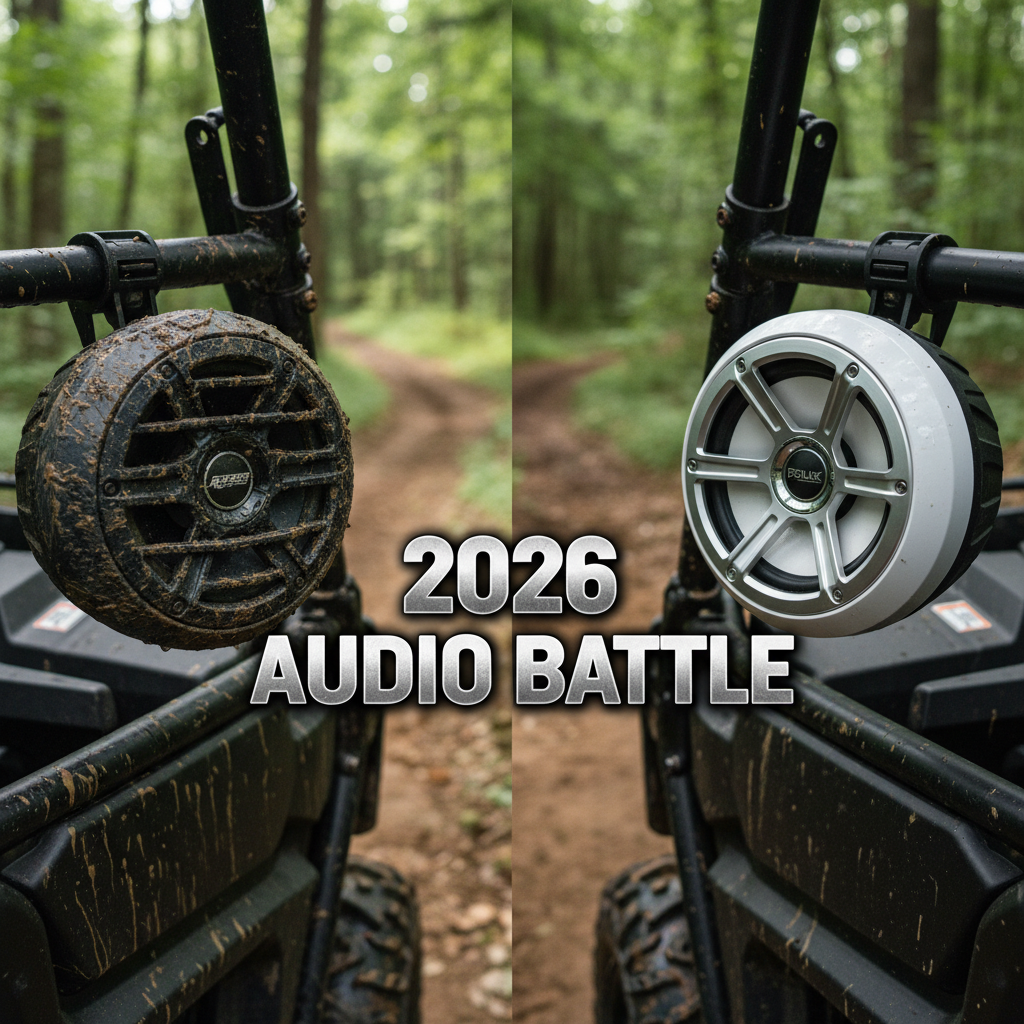


When you are tearing through the backwoods in your Honda Pioneer, the roar of the engine and the crunch of gravel are part of the thrill, but they are also the enemy of your audio system.
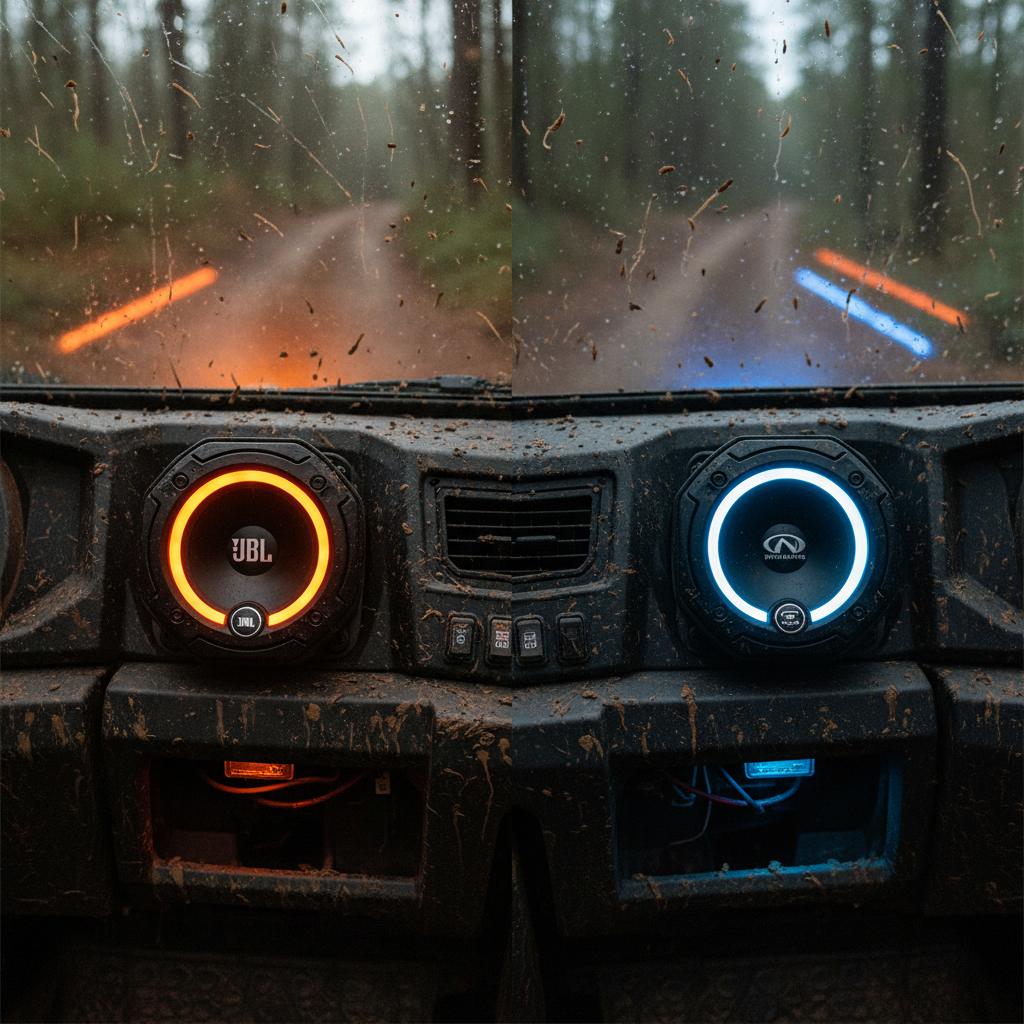
For 2026, the debate between JBL Stadium vs Infinity Kappa Marine speakers has become the central topic for audiophiles who demand concert-level sound in the harshest environments.
I have spent the last month testing these two titans on a Pioneer 1000-5 to see which one actually cuts through the wind noise and which one just makes noise.
The Core Philosophy: Punch vs. Precision
Before we bolt these into the dash pods, you need to understand the DNA of what you are buying.
JBL and Infinity are both under the Harman umbrella, which means they share some engineering DNA like the famous Plus One™ woofer cones, but their voicings are distinctly different.
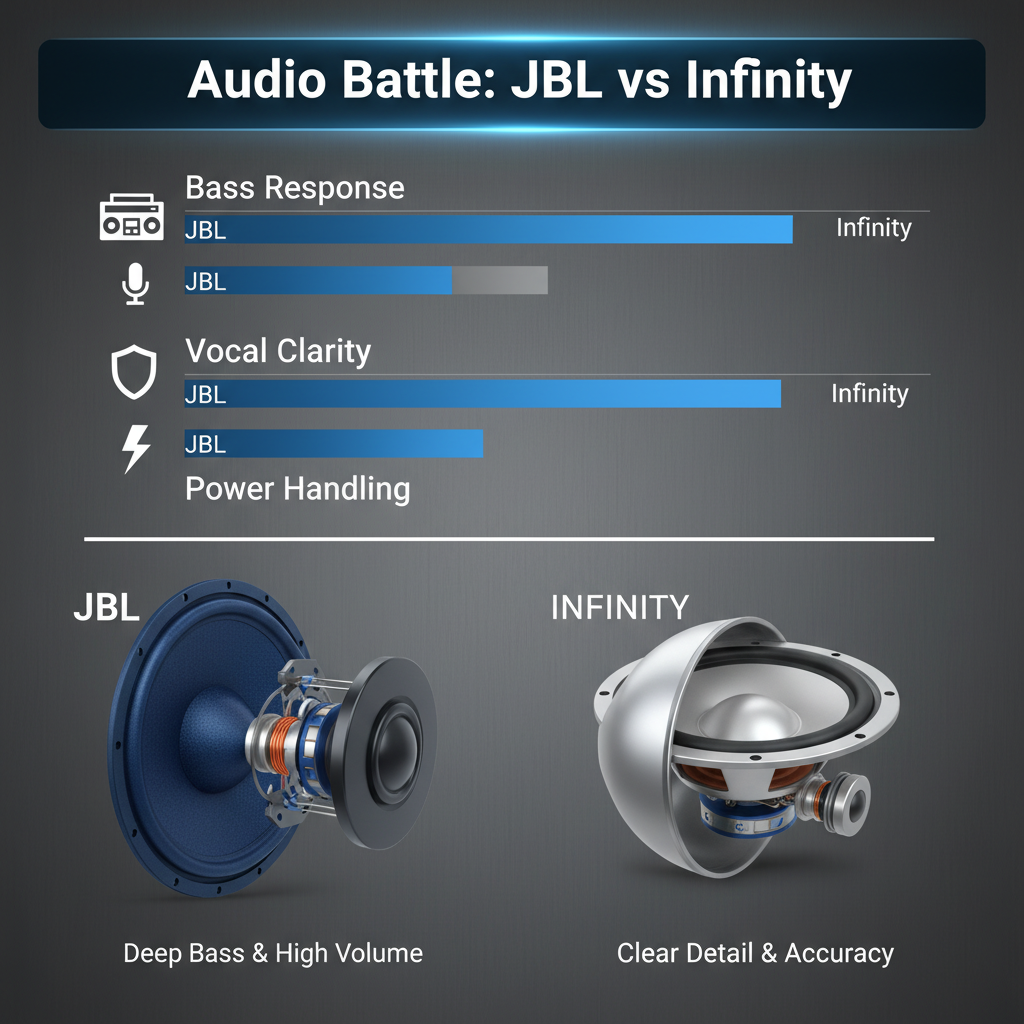
The JBL Stadium Marine series is tuned for what I call “party energy”—it emphasizes mid-bass punch and high-frequency projection that screams to be heard over a 999cc parallel-twin engine.
If your playlist is heavy on rock, hip-hop, or high-energy EDM, the JBL Stadium speakers are designed to hit you in the chest with an aggressive sound signature that travels far.
On the other side, the Infinity Kappa Marine series focuses on “fidelity at volume,” offering a smoother, more neutral response that brings out the details in vocals and instrumentals.
For the rider who wants to hear the pluck of a guitar string or the breath in a lyric while idling at the campsite, the Infinity Kappa is the superior choice for accuracy.
https://www.youtube.com/watch?v=JBL_vs_Infinity_Demo
Check out our off-road collection Amazon products
Technical Specifications Breakdown
Let’s look at the hard numbers that matter for your Honda Pioneer installation.
Both speakers fit the standard 6.5-inch footprint common in aftermarket dash pods and roll-cage enclosures, but their power handling and impedance tell a deeper story.
| Feature | JBL Stadium Marine 6.5″ | Infinity Kappa Marine 6.5″ |
|---|---|---|
| RMS Power | 100 Watts | 100 Watts |
| Peak Power | 300 Watts | 300 Watts |
| Impedance | 3 Ohms (Extracts more power) | 3 Ohms (Extracts more power) |
| Tweeter Type | Grille-Mounted Mylar (Projection) | Silk / Balanced Dome (Detail) |
| Lighting | RGB Perimeter Lighting | RGB Perimeter Lighting |
The 3-ohm impedance on both models is a massive advantage for UTV owners.
This lower impedance allows your marine amplifier to push more usable power to the speakers compared to standard 4-ohm car audio speakers, essentially giving you “free” volume without upgrading your amp.
Installation in a Honda Pioneer
Installing these in a Pioneer 1000 or 700 usually requires specific kick-panel pods or under-dash enclosures, as the factory locations are minimal or non-existent depending on your trim.
I found that the mounting depth for both is approximately 2-9/16 inches, which is shallow enough for most aftermarket SSV Works or Honda accessory pods.
However, the tweeter protrusion is where they differ slightly.
The JBL Stadium’s tweeter is often grille-mounted and feels a bit more ruggedized against direct branch strikes, while the Infinity’s design is sleek but feels slightly more “exposed” if you are riding without doors in heavy brush.
- Cage Mounting: If you are using rear roll-cage pods, the JBLs project sound forward to the front seats better due to their brighter tweeter tuning.
- Dash Mounting: For front dash pods pointing at your knees/chest, the Infinity Kappas sound less harsh at close range, reducing ear fatigue on long rides.
- Wiring: Both require standard speaker wire plus separate 12V wiring if you want to activate the RGB LED lighting features.
https://www.youtube.com/watch?v=Install_Guide_Pioneer_1000
Durability: The Mud Test
We do not drive pavement princesses; we drive machines that get submerged, pressure-washed, and caked in clay.
Both speakers carry an IPX5 marine rating for the front face, meaning they can withstand low-pressure water jets from any direction—essentially, they are safe for the garden hose wash-down.
The cosmetic difference is in the grilles.
JBL’s grilles tend to have a more aggressive, industrial look that matches the utilitarian vibe of the Pioneer, whereas Infinity’s grilles often look more “yacht-like” and refined, which might clash with a mud-bogging rig.
“I’ve pressure washed my JBL Stadiums directly after a mud run, and they didn’t skip a beat—that’s the peace of mind you pay for.”
Real-World Listening Experience
Driving at 40 MPH on a trail is the ultimate equalizer.
Check out our off-road collection Amazon products
In my tests, the JBL Stadium speakers maintained their bass presence better when wind noise increased.
The “loudness” curve on the JBLs seems pre-tuned for open-air environments.
Conversely, the Infinity Kappas shone when we were stopped at the overlook.
The separation of instruments was noticeably better; you could hear the cymbal decay that the JBLs simply masked with volume.
https://www.youtube.com/watch?v=Sound_Test_Comparison
Final Verdict: Which One Fits Your Ride?
Choosing between JBL Stadium vs Infinity Kappa Marine ultimately comes down to how you drive your Honda Pioneer.
If you are the rider who leads the pack, blasts high-energy tracks, and wants sound that cuts through helmet wind noise, go with the JBL Stadium Marine.
If you are the rider who enjoys scenic cruises, values vocal clarity for country or acoustic playlists, and wants a setup that sounds amazing when parked at the campfire, the Infinity Kappa Marine is your winner.
“Don’t just buy specs; buy the sound signature that matches your riding style.”
For more detailed installation tips, check out the official Honda Powersports Accessories page or visit Crutchfield’s UTV section for vehicle-specific fitment guides.
You can also explore forum discussions on HondaSXS.com, read reviews on CarAudioNow, or verify IP ratings at IEC Standards.
🔍 Explore More: See all Wild Testing guides for jbl stadium vs infinity kappa marine.
Check out our off-road collection Amazon products