

Honda Talon vs Polaris RZR Turbo: Which Sport UTV Dominates the Dunes and Trails?
The sport side-by-side segment is a battleground of power, technology, and adrenaline. At the heart of this high-octane rivalry are two titans: the naturally aspirated, technologically advanced Honda Talon and the raw, turbocharged powerhouse, the Polaris RZR Turbo.
For the serious off-road enthusiast, the decision between the two is a deeply personal one, pitting Honda’s legendary reliability and innovative Dual-Clutch Transmission (DCT) against the RZR’s industry-leading horsepower and sophisticated DYNAMIX suspension.
The question of honda talon vs polaris rzr turbo is a classic debate of precision engineering versus brute force.
I’ve had the privilege of pushing both of these machines to their limits—the Talon feeling like a finely tuned race car with its crisp shifts, and the RZR Turbo feeling like a rocket ship, eager to devour any terrain. Your choice will ultimately come down to your preferred style of riding: do you want the bulletproof, engaging drive of the Honda, or the sheer, exhilarating speed and massive aftermarket support of the Polaris?
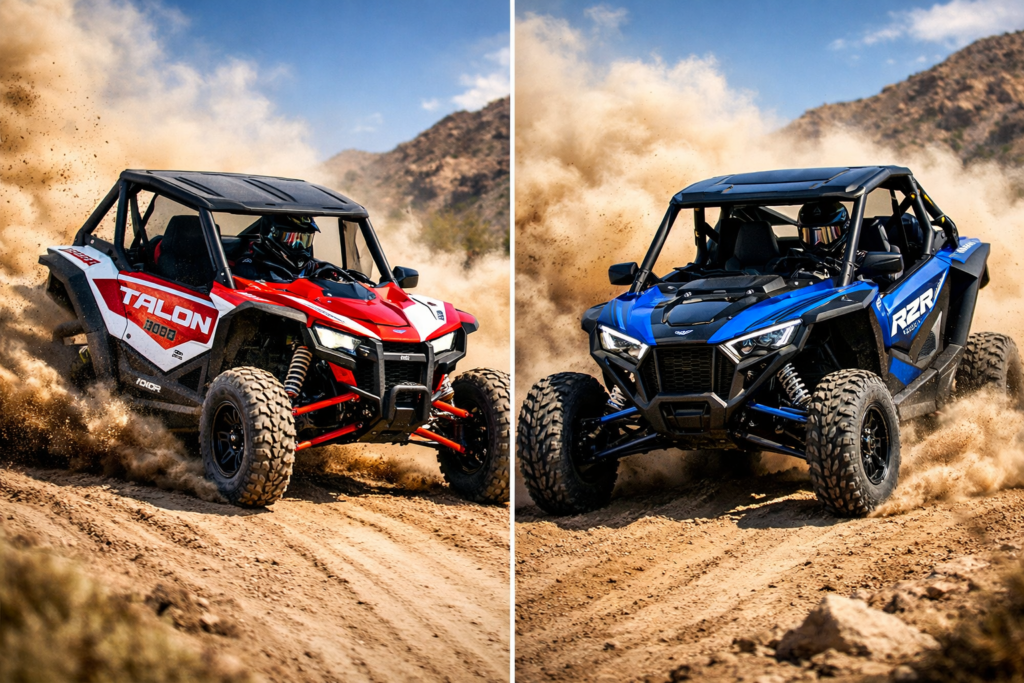
The Honda Talon and Polaris RZR Turbo, two distinct approaches to high-performance off-roading.
Engine and Transmission: DCT Precision vs. Turbo Power
This is where the core difference between the two machines lies. The Polaris RZR Turbo models are defined by their name: a powerful, turbocharged engine that delivers massive horsepower—often in the 168 to 181 HP range, depending on the model year. This raw power is delivered through a Continuously Variable Transmission (CVT). The CVT is simple, effective, and allows the engine to stay in its power band, resulting in explosive acceleration and top-end speed that is hard to beat [1].
The Honda Talon, on the other hand, is powered by a naturally aspirated 999cc parallel-twin engine, producing around 104 HP. While this is significantly less power than the RZR Turbo, the Talon compensates with its revolutionary Six-Speed Dual-Clutch Transmission (DCT). The DCT offers true, gear-on-gear shifting, eliminating the belt-slippage, heat, and maintenance issues associated with CVTs. The driver can choose between fully automatic, paddle-shifted manual, or Sport mode, providing an incredibly engaging and reliable driving experience [2].
For high-speed desert running and dune climbing, the RZR Turbo’s horsepower advantage is undeniable. However, for technical trail riding, rock crawling, and long-term reliability, the Talon’s DCT and lack of a belt system offer a level of confidence and control that many enthusiasts prefer. The Talon’s engine braking is also superior, a huge advantage on steep descents.
Performance and Drivetrain Comparison
| Feature | Honda Talon (1000R/X) | Polaris RZR Turbo (Pro XP) |
|---|---|---|
| Engine Type | 999cc Parallel-Twin (Naturally Aspirated) | 925cc/999cc Twin-Cylinder (Turbocharged) |
| Approx. Horsepower | 104 HP | 168 – 181 HP |
| Transmission | 6-Speed Dual-Clutch (DCT) | Continuously Variable Transmission (CVT) |
| 4WD System | I-4WD (Intelligent 4WD) | On-Demand True AWD |
Suspension Technology: Live Valve vs. DYNAMIX
Both manufacturers have embraced active suspension technology, partnering with FOX to deliver systems that adjust damping on the fly. The Honda Talon utilizes FOX Live Valve shocks, which are controlled by a Bosch ECU. This system constantly monitors vehicle speed, steering angle, brake pressure, and throttle position to adjust the compression and rebound of the shocks in milliseconds. The Talon offers two main modes: Normal and Sport, allowing the driver to select a baseline feel [3].
The Polaris RZR Turbo, particularly the Pro XP and Turbo S models, features the DYNAMIX Active Suspension system. DYNAMIX also uses FOX Live Valve shocks and a similar ECU, but Polaris offers a more immersive user experience. The RZR’s system typically offers three modes—Comfort, Sport, and Firm—and integrates with a dash display that shows the shock data in real-time. This extra level of user control and feedback is a key differentiator for the RZR [4].
In terms of raw travel, the RZR Turbo S and Pro XP often boast longer suspension travel numbers than the Talon, which translates to a slightly more forgiving ride when hitting massive whoops at high speed. However, the Talon’s suspension is tuned for exceptional stability and predictability, making it incredibly confidence-inspiring on technical terrain and during aggressive cornering.
Reliability and Aftermarket: Longevity vs. Customization
The debate of honda talon vs polaris rzr turbo often boils down to reliability versus customization. Honda has built its reputation on bulletproof engineering, and the Talon is no exception. The DCT transmission is a major factor here, as the elimination of the drive belt means one less critical component to worry about breaking on the trail. For riders who value minimal maintenance and maximum time on the trail, the Talon’s Honda DNA is a huge draw.
The Polaris RZR, while significantly more reliable than its early generations, still uses a CVT, which requires periodic belt maintenance and replacement, especially under the stress of a turbocharger. However, the RZR’s decade-long dominance in the sport UTV market has created an unrivaled aftermarket ecosystem. If you want to customize every aspect of your machine—from engine tunes to long-travel kits—the RZR has a massive advantage. Parts are readily available, and nearly every off-road shop is familiar with the platform [5].
For the average enthusiast, the Talon offers a fantastic, reliable package right off the showroom floor. For the hardcore racer or custom builder, the RZR Turbo provides the horsepower and the platform for endless modification.
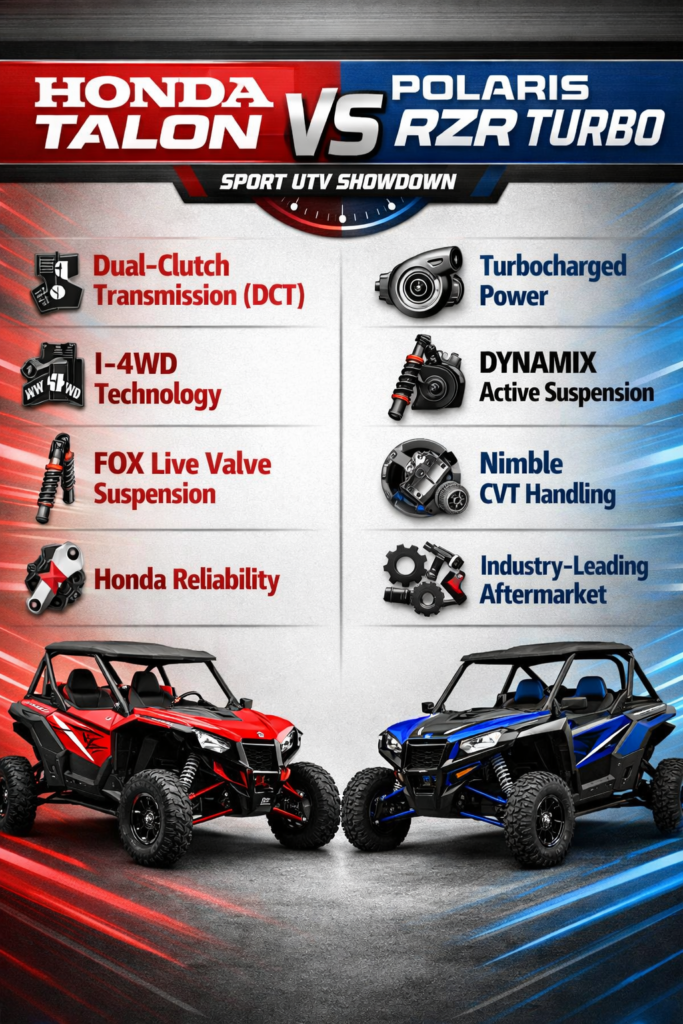
A visual breakdown of the key differences in the sport UTV segment.
The Final Verdict: Which UTV is Right for You?
Choosing between the honda talon vs polaris rzr turbo is a choice between two excellent, but fundamentally different, philosophies of off-roading. Both will provide an incredible experience, but they cater to different priorities.
Choose the Honda Talon if:
- You prioritize reliability and low maintenance, especially the peace of mind that comes with a belt-less DCT transmission.
- You enjoy a more engaging, driver-focused experience with true gear shifts and superior engine braking.
- Your riding consists of technical trails, rock crawling, and aggressive cornering, where the Talon’s stability and precision shine.
Choose the Polaris RZR Turbo if:
- You crave maximum horsepower and top-end speed for high-speed desert running and dune riding.
- You want the most advanced, customizable active suspension system with real-time feedback (DYNAMIX).
- You plan on extensive aftermarket customization, benefiting from the RZR’s massive parts and support network.
Ultimately, the Talon is the machine you buy if you want to drive it hard, put it away, and know it will start every time. The RZR Turbo is the machine you buy if you want to go faster than everyone else and have the ability to endlessly tweak and upgrade your ride. Either way, you’re winning the off-road game.
Best regards,
Recommended Resources
- Video: Honda Talon 1000X-4 Live Valve Vs Rzr XP 4-Seater Drag Race (25:15) – A detailed, real-world comparison and drag race between the two four-seater models, highlighting the power difference.
- Video: HEAD-TO-HEAD DEMONSTRATION. RZR XP 1000 VS HONDA TALON (16:45) – A comprehensive look at the interiors and features of both machines.
- Outbound Link: Super ATV: DCT vs. CVT—What’s the Best UTV Transmission? – An excellent technical breakdown of the transmission types used in both vehicles.
- Outbound Link: ATV.com: Honda Talon Live Valve Vs. Polaris RZR Dynamix: Suspension Comparison – A deep dive into the active suspension technology.
References
- RZR Forums: Roast my decision to buy a Talon vs RZR
- Talon SXS Forum: Talon vs RZR
- ATV.com: Honda Talon Live Valve Vs. Polaris RZR Dynamix: Suspension Comparison
- Chupacabra Offroad: 300 Miles on my New RZR Turbo S Dynamix
- Reddit: Thoughts? Honda talon vs Polaris rzr